
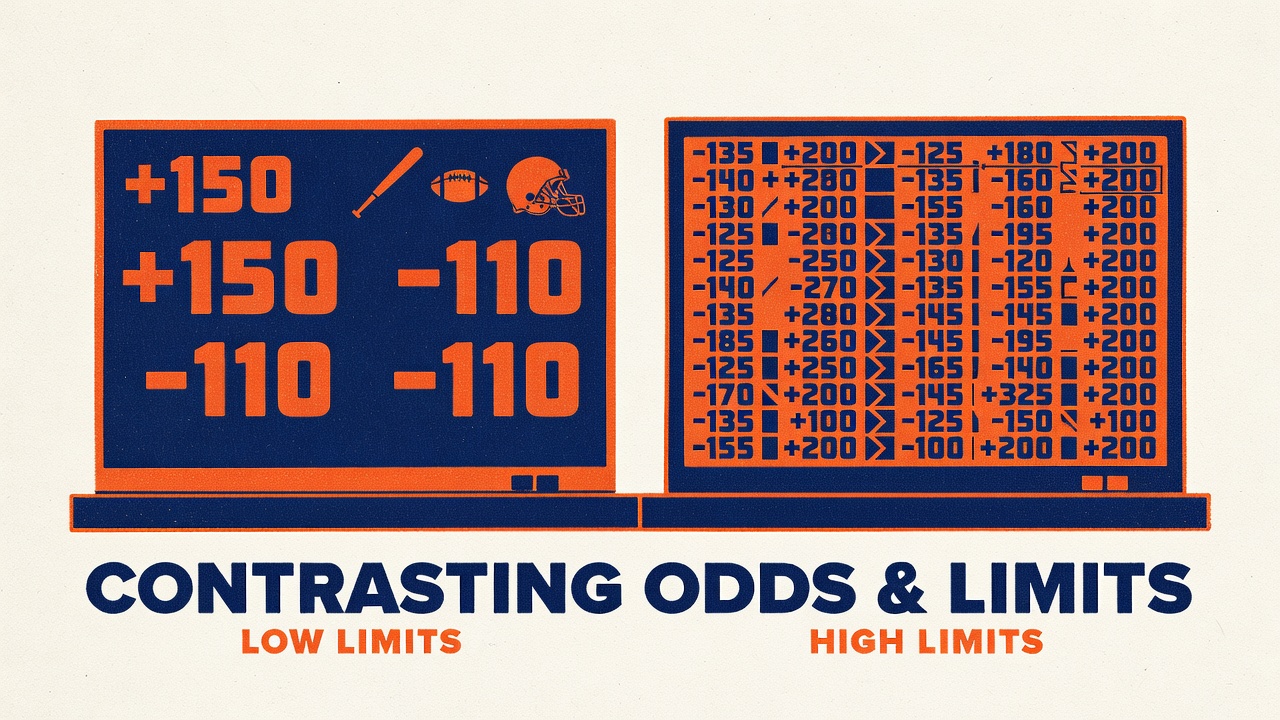
A soft book is a sportsbook that doesn't mind losing money. A sharp book is one that does. That's essentially it, though apparently this distinction matters enough to fill thousands of words.
Imagine two guys running a casino. One guy wakes up and thinks, "I hope I lose a million dollars today." The other guy thinks, "I prefer not to do that." The first one is running a soft book.
The Real Difference
Sharp books employ mathematicians. They employ people whose job is to understand exactly how much money they will make or lose based on every single bet placed. Soft books employ optimists. Not in a charitable way. In the sense that they hope things work out okay.
A soft book might take action on anything. They'll balance bets like a bartender with a good feel for the crowd. Line moving up? More people are betting one side. So they move the line to attract action the other way. It's simple. It's intuitive. It's also how you go bankrupt.
A sharp book moves lines based on math that would make you nauseous. The line isn't there to balance action. The line is there because a computer that costs more than your house calculated what it should be. If nobody wants to bet at that line, that's fine. The sharp book doesn't care about action volume. They care about edge.
The Business Model Problem
Soft books survive by volume and luck. They need a lot of bets from a lot of people who are slightly worse at predicting outcomes than they are. This works until it doesn't. A few weeks of sharp bettors showing up and moving against your lines, suddenly you're in a hole you can't climb out of.
Sharp books survive by edge. They know what the true odds are. They price their lines accordingly. When sharp bettors come in, these books are already compensating. The sharp bettor might think they spotted something. What they've spotted is that the line already accounts for what they spotted.
The technical distinction is margins. A soft book might have a 4-5% margin built into their lines. That means they're offering worse odds than the real probability warrants. They're banking on volume to overcome their edge against smart money.
A sharp book runs on 2-3% margins or sometimes less. They're already so efficient in their pricing that they don't need huge edge. They just need volume and accuracy.
Who Bets Where
Casual bettors, people who bet on their favorite team regardless of line value, end up at soft books. That's not an insult. It's just how it works. You're betting on the Dolphins because you like them, not because you've calculated that the line offers value.
Sharp bettors run toward sharp books. Or they did, before so many sharp books disappeared. The 2010s saw a contraction. The houses that couldn't sustain sharp money faded out. The ones that remained got sharper.
DraftKings, FanDuel, Caesars, Bet365, these are sharp operations now. Their lines move with market efficiency. They don't care about balanced action. They care about getting to the real number first.
The Death of the Soft Book
The era of soft books is basically over in the major markets. You find them in smaller operations, or in prop bets, or in niche sports that don't get enough sharp attention. A soft book on the Super Bowl is a fantasy. Too much smart money has already scouted that territory.
The last soft books that remain are either regional operations, or they're taking calculated losses on certain bets to acquire customers they can then beat over time.
So when you hear someone talk about finding a soft line, what they usually mean is they found a sportsbook that hasn't moved fast enough to the right number yet. That window closes quickly. It's not a business model anymore. It's an accident.