Baccarat arrived in Europe from Italy in the 15th century. By the 17th century, it was the game of choice for French nobility. When colonial administrators carried French culture to Vietnam and Cambodia, baccarat came too. It became the national card game of Asia, particularly in Macau and Hong Kong.
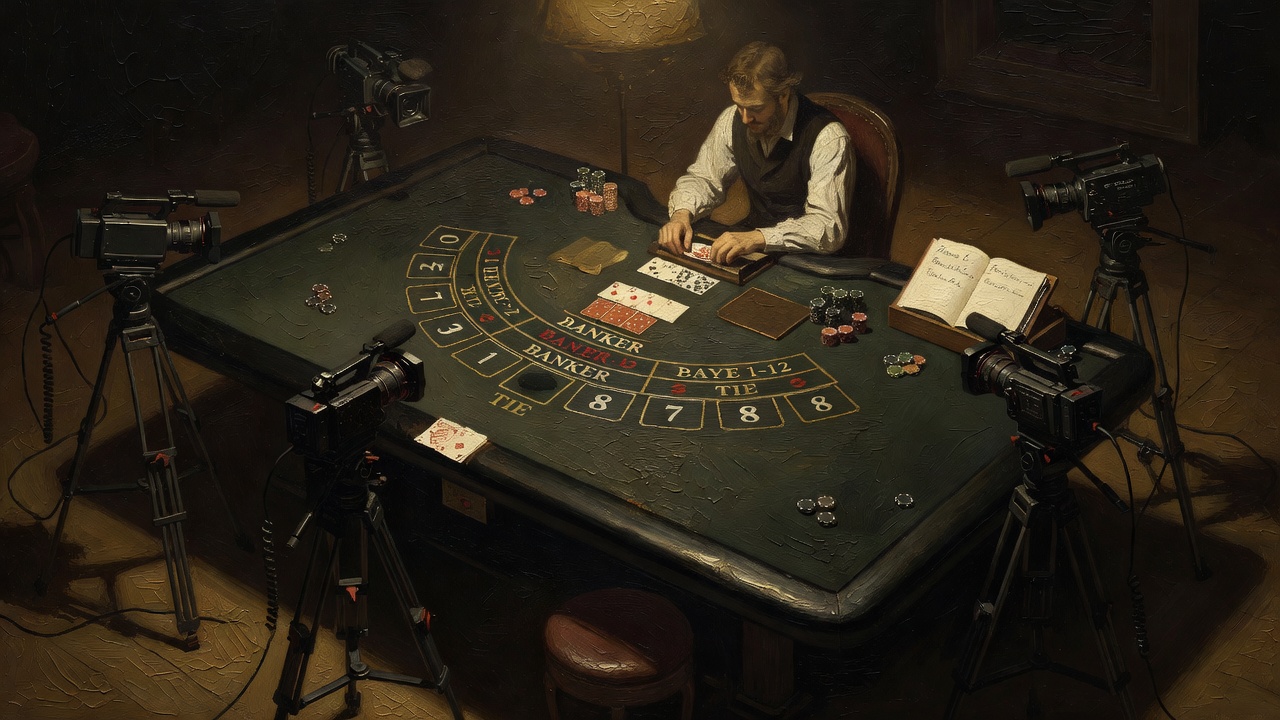
Live dealer baccarat is the modern version of this ancient game. Instead of a table in a Macau casino, you have a stream from a studio, cards dealt by a real person, and real money wagered from your phone. The rules have not changed since the 1600s.
The Rules
You wager on three outcomes: the player hand wins, the banker hand wins, or the game ties. The dealer deals two cards to the player, two cards to the banker. Cards are valued 0-9. Face cards are zero. Aces are one. 10 is zero. All other cards are face value. The hand total is the last digit of the sum. If the player has a 7 and a 5, the total is 12, which reads as 2.
When both hands have two cards, the total is compared. Highest total wins. If a hand is 8 or 9 (a natural), no further cards are dealt. If not, a third card rule applies: player must hit on 0-5, stands on 6-7. Banker's third card rule is more complex, based on what the player drew.
The game resolves after third cards are dealt. The hand totals are compared. Highest total wins. The winner pays out at 1:1 (player wins) or 0.95:1 (banker wins due to commission). A tie pays 8:1.
The House Edge
The house edge on the player bet is 1.24%. On the banker bet, it is 1.06%. The tie bet has a 14.4% house edge. Most players avoid the tie bet. The choice is between player and banker, both of which have comparable house edges.
Data from millions of hands shows that the banker wins slightly more often than the player due to the drawing rules. The commission (paying 0.95 instead of 1.0 on banker wins) accounts for this difference. Mathematically, player and banker are roughly equivalent.
Live Dealer Dynamics
Live dealer baccarat changed the game in two ways. First, it allowed Asian players to play from home during COVID, preventing total market collapse. Second, it created a social experience: players see the dealer, see other players' bets via chat, develop community.
The pacing of live dealer games is slower than electronic baccarat. A real dealer takes 30-40 seconds to deal and resolve a hand. Electronic versions take 10 seconds. This matters for bankroll: a player betting 100 dollars per hand plays 3-4 hands per minute at live dealer, versus 6 per minute electronic. Same house edge, lower loss rate.
Historical Persistence
Baccarat has persisted for 600 years because it is simple. The rules are transparent. The house edge is fair compared to other games. The drama of natural 8 and natural 9 creates narrative. Unlike poker, which rewards skill, or blackjack, which requires strategy, baccarat is pure chance. This makes it ideal for casual players.
The game is most popular in Asia, where it has cultural resonance. In Europe and North America, it exists but attracts fewer players. The rule of natural 8 and natural 9 is distinctly Asian; European players often find the rules arbitrary.
Live dealer baccarat is the oldest game format transported into digital space. It works because the simplicity translates. A hand of baccarat has not changed since the Ming dynasty. The only change is that now you play from home.