The gentleman, one shall call him only Mr. F, maintains a discretionary account of eight figures with an operator that shall remain undescribed beyond that it is licensed under the Gibraltar regime. On a Tuesday evening in late autumn, from a corner suite whose name I am under no obligation to supply, Mr. F was playing Evolution's no-commission baccarat at a stake not worth dwelling upon.
The feed froze at the squeeze.
This matters. One understands that elsewhere a buffering video is a minor nuisance, a thing to be resolved with a sigh and a refresh, but in the present setting, in a room where a five-card coup rides on the precise visibility of a second-card reveal, a frozen feed is an insult with a number attached.
I was asked, discreetly, to intervene. What I learned in the two hours that followed is, on reflection, the basis of a useful piece of writing for the general reader, who will never play at Mr. F's denomination but will encounter precisely the same technical defects in his own modest sessions.
A First Principle
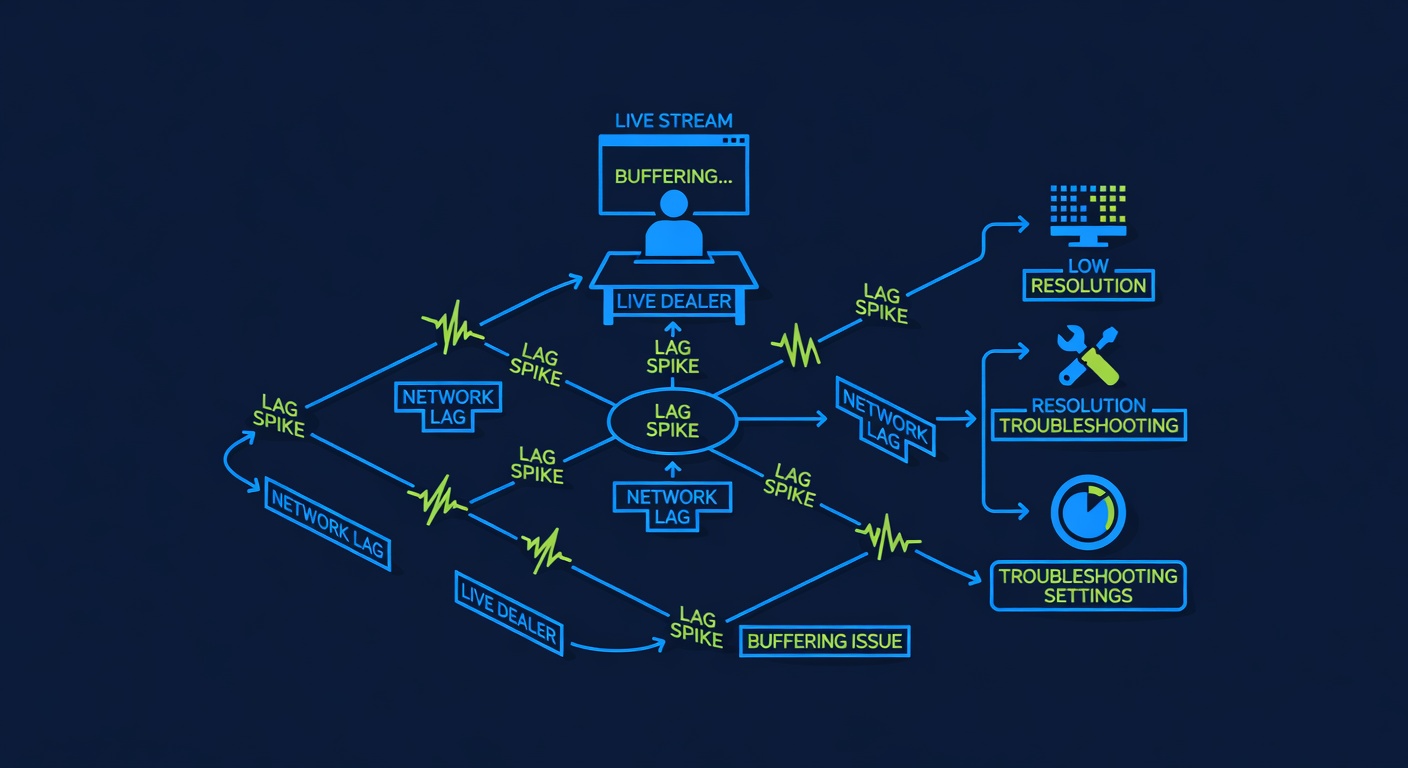
A buffering issue in a live dealer product is never one problem. It is, without exception, a compound of at least three, arranged in an order that rewards methodical diagnosis and punishes impatience. The reader should work from the device outward, rather than from the casino inward, because the casino's side of the equation is, in nearly all cases of buffering, entirely innocent.
The Device Itself
One begins at the terminal. A laptop that has been open for nine hours of professional work, with twenty-six Chrome tabs and three Slack instances, is not a device for streaming a live video feed. One closes the tabs. One closes the applications one did not realize were running. One restarts the browser. This resolves, in my experience, slightly under half of all reported buffering incidents.
If the device is mobile, the question becomes one of thermal state. A phone that has been in direct afternoon sun, or in a pocket during a warm commute, will throttle its processor to preserve battery, and the first casualty of that throttling is always video decoding. The remedy is boring: place the device on a cool surface, allow five minutes, refresh. The buffering disappears with the heat.
The Network
A home Wi-Fi router is a mechanical device with a working life. Beyond roughly three years of continuous operation, most consumer routers begin to accumulate small failures that manifest as inconsistent bandwidth delivery under sustained video streaming. Mr. F's suite network, needless to say, was not the problem. The reader's home network, often, is.
The diagnostic sequence:
- Run a speed test while the live dealer client is open but before placing a wager. A live dealer HD feed requires a sustained 5 to 8 Mbps downstream. Most broadband connections can deliver this. Most home Wi-Fi cannot always do so.
- If the speed test shows a wide gap between the wired connection and the Wi-Fi, the router is the problem. Move closer. Switch to 5 GHz if you have been using 2.4 GHz. Restart the router.
- If the wired connection is also slow, contact the broadband provider. A line fault at 9pm local time will not resolve on its own, and the live dealer session will not hold together on a degraded line.
The Browser Tier
A live dealer feed is delivered via a streaming protocol, most commonly HTTP Live Streaming or DASH, and the browser's ability to decode that stream depends on hardware acceleration being available and functioning. In Chromium-based browsers, hardware acceleration can be disabled by a third-party extension without notice to the user. Disabling ad blockers temporarily, clearing the browser cache, and confirming that hardware acceleration is on in browser settings resolves a disproportionate share of mysterious buffering complaints.
For Mr. F, the problem turned out to reside one level above this. His suite was fitted with an enterprise-grade network appliance whose deep packet inspection was throttling streaming protocols on a schedule that the building management had not thought to document. The appliance was disabled on his behalf within forty minutes, through channels one is not at liberty to describe.
The lesson transposes, downward, to the domestic reader. A corporate or university network, a VPN, a content-filtering router, a misconfigured firewall on a home office PC: any of these can interpose itself between the player and the feed with results that appear random but are, on inspection, deterministic.
The Operator's Studio
Every so often the casino itself is at fault. When a major Evolution or Pragmatic Play studio experiences a partial outage, the symptom at the player level is indistinguishable from a local network problem: buffering, freezing, audio desynchronization. The tell is that the issue affects multiple games simultaneously and affects multiple players in the same table chat.
The remedy is to switch tables. If the issue persists across tables and providers, the issue is local. If the issue is confined to one studio, the studio is working through its incident.
A Note on What You Should Not Do
Never place, increase, or double a wager while the feed is buffering. The shoe is being dealt in the studio regardless of whether you are watching it, and the house is under no obligation to rule in your favor on a contested wager if you wagered blind.
This is, to my continuing astonishment, the single most common error committed by experienced players during a buffering incident. The urge to keep playing through is strong. Resist it. Pause the session, resolve the issue, resume.
The Outcome
Mr. F's session was restored by midnight. He resumed play, lost a meaningful sum at baccarat over the following three hours, and retired to bed at approximately four in the morning with the composure of a man for whom the loss was, in the grand arithmetic of his evening, a rounding error.
He thanked the staff individually on his way out. He tipped generously. He requested, and was granted, a complimentary glass of something that had been opened that afternoon in the wine room for a guest who had failed to appear.
The technical incident was forgotten within hours. The grace with which he conducted himself was not. In our profession one remembers the manner of a man more than the balance of his account, and this, perhaps, is the only lesson of the episode worth setting down.