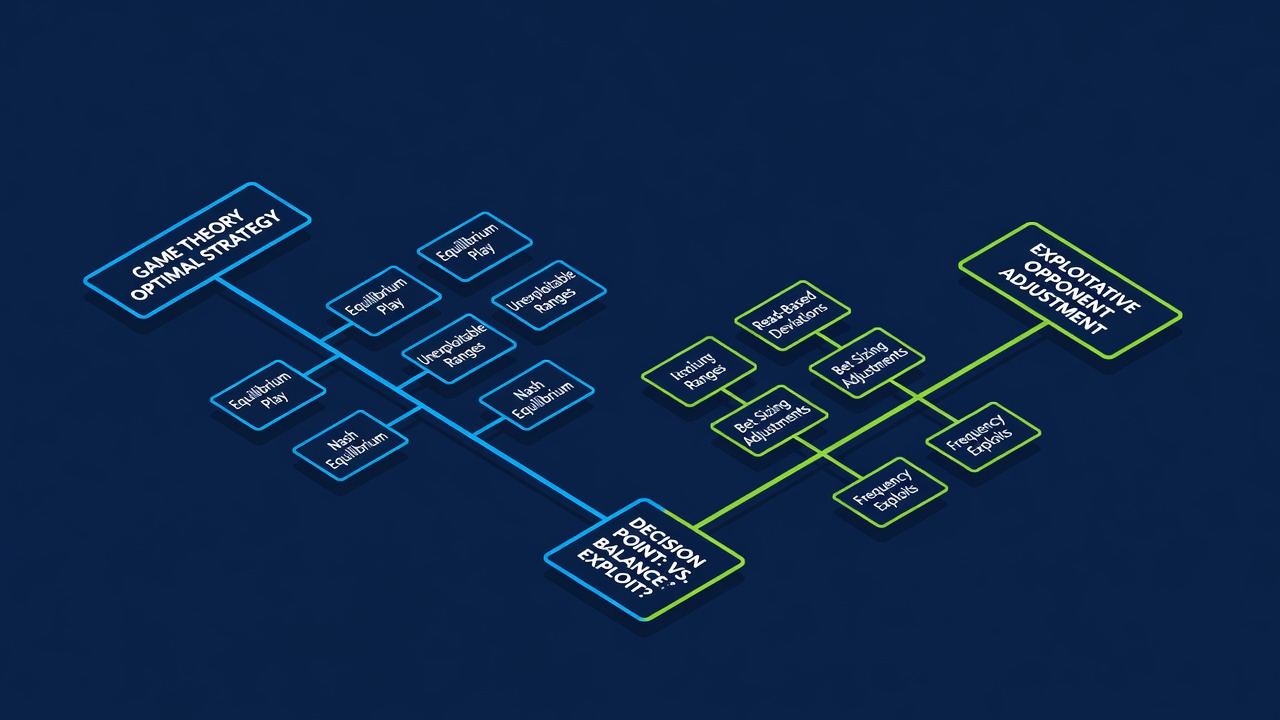
Game Theory Optimal poker is a strategy designed so that no opponent can exploit you. It is mathematically balanced. It assumes perfect opponents playing optimally. In practice, no opponent plays GTO. This creates the exploitative opportunity: you deviate from GTO in ways that punish your opponents' specific mistakes.
The data on GTO adoption is stark. Among professional poker players, GTO understanding has become standard. Among casual players, GTO is unknown. The divide creates opportunity: professionals can exploit casual players by deviating in specific ways while remaining unexploitable.
The Mathematics of GTO
GTO strategy for specific situations is calculated using solvers: PIOSolver, GTO Plus, and similar tools. A solver takes a game tree, defines player actions, and calculates the strategy that maximizes expected value against a perfectly playing opponent. The result is a mixed strategy: play this action 40% of the time, this action 50% of the time, this action 10% of the time.
GTO players use these mixed strategies. They randomize their decisions to prevent opponents from exploiting patterns. If a GTO player always raises with premium hands and checks with weak hands, an opponent will learn this and adjust. By randomizing, GTO players become unexploitable.
Calculating GTO for an entire game is computationally intense. Modern solvers can calculate GTO for simplified scenarios (heads-up cash games, specific positions). Full-game GTO for a six-person table is computationally infeasible even today.
Exploitative Play Against Weak Opponents
Weak opponents make specific mistakes. They fold too much to aggression. They bet weak hands. They call too much with marginal hands. Exploitative strategy responds to these mistakes: bet more to exploit weak folding, check back to avoid being bluffed, tighten calling range against strong opponents.
Data from tracking thousands of hands shows that exploitative play against weak opponents generates 40-60% more profit than GTO play. The reason is simple: GTO assumes perfect opponents. Weak opponents are not perfect. The deviation from GTO that exploits weakness is profitable.
The catch is that exploitative play is counterable. If you always bet when opponents fold too much, they eventually learn and adjust. At which point your exploitative strategy becomes unprofitable.
The Practical Choice
In a casual game with weak opponents, exploit. Identify their mistakes and make bets that specifically target those mistakes. A player who folds too much? Bet your whole range. A player who calls too much? Bet only strong hands.
In a high-stakes game with skilled opponents, GTO becomes necessary. You cannot exploit because your opponents are not making obvious mistakes. Deviating from GTO gets punished. Your best option is to play balanced, balanced, balanced.
Data from online poker shows that the transition point is around 25-big-blind buy-ins per hand. Below that level, exploitative play wins. Above that level, GTO wins. The reason is that higher stakes attract more skilled players.
The Hybrid Approach
Top professionals do not play pure GTO or pure exploitative. They play a hybrid: they start with a GTO framework and adjust for specific opponents. This is called "balanced exploitative play." They make most of their decisions according to GTO principles, but they adjust betting sizes and frequencies based on opponents' mistakes.
This requires extensive experience reading opponents and understanding the math simultaneously. It is harder than pure GTO (which is mechanical) and harder than pure exploitative (which is simple). But it generates the best results.