In 1962, Edward Thorp published "Beat the Dealer," a book that changed gambling forever by proving, mathematically, that card counting could beat blackjack. Thorp was a mathematics professor, not a professional gambler. He approached blackjack as a problem to solve.
Blackjack, unlike most casino games, has memory. The cards you see affect the probability of the cards you will see next. If an ace has already been dealt, there is one fewer ace in the remaining deck. This seemed obvious, but no one had quantified what it meant for betting strategy.
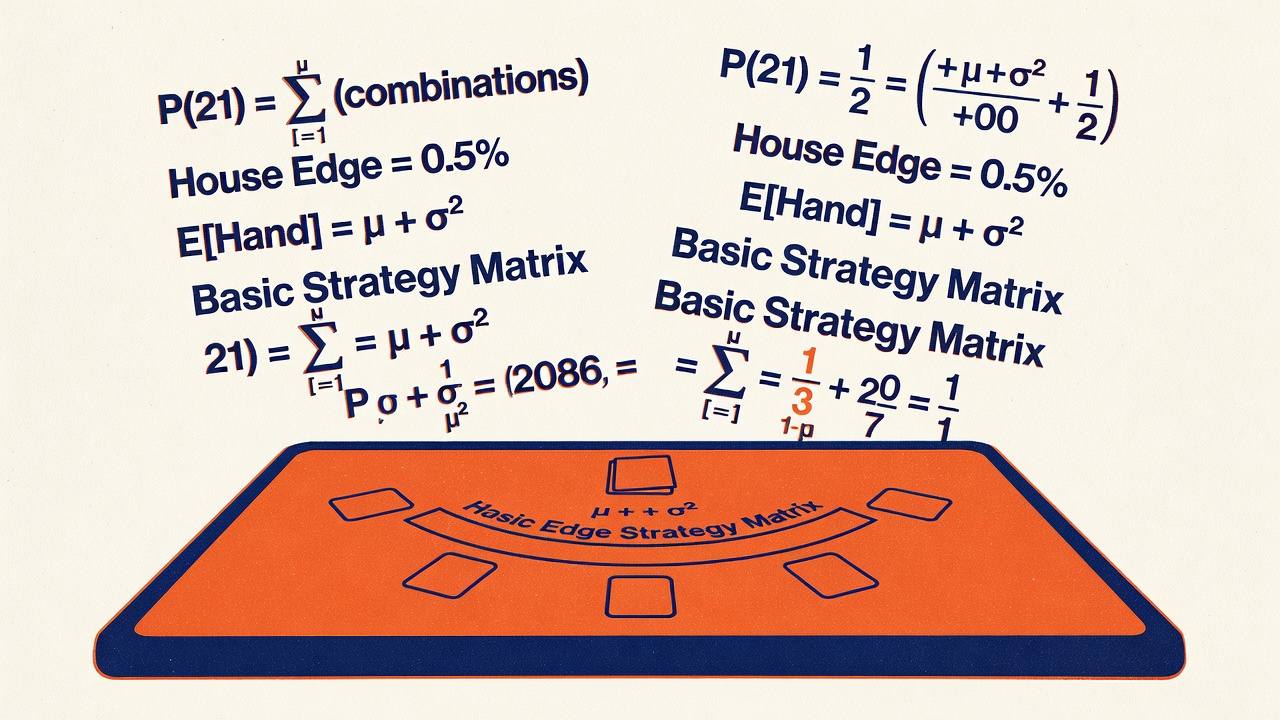
Thorp worked with a computer (one of the first computers, before personal computers existed) to analyze blackjack from first principles. He modeled every possible game state: what cards have been dealt, what hands are possible, what bet sizing maximizes long-term profit. The output was a single chart: the Basic Strategy.
Basic Strategy: The Revolution
Basic Strategy told players, for every possible hand they could have versus every possible dealer upcard, what the mathematically optimal play was. Hit or stand or double or split, based on pure mathematics, not intuition.
A player who memorized and followed Basic Strategy reduced the house edge on blackjack from 4 percent (roughly) to 0.5 percent. This was revolutionary. For the first time, a casino game had been proven to have a learnable strategy that reduced the house advantage by 85 percent.
Thorp then went one step further. He identified which cards, when they were removed from the deck, hurt the casino most. Aces and tens. When aces and tens were depleted from the deck, the house edge increased. When aces and tens were abundant in the remaining deck, the player edge increased.
From this insight, card counting was born. A player who kept track of aces and tens (simplifying his count) could adjust their bet size when the count was favorable (player edge) and minimize bet size when the count was unfavorable (house edge). This was the method that would later be used by the MIT blackjack teams and the professional card counters who won millions.
The Industry Response
Casinos did not immediately ban card counting. They banned Basic Strategy players from taking action. They wanted players to make mistakes and lose money. A player playing perfectly made them uncomfortable.
By the time casinos realized card counting was a real threat (late 1960s, early 1970s), the practice was already spreading. The industry responded by introducing multiple decks, frequent shuffling, and rules changes that hurt the player. None of these measures stopped card counting, but they made it harder and narrower in edge.
The Legacy
Thorp's book did two things: it proved that casino games could be beaten through mathematics and discipline, and it created an entire subculture of professional card counters who would spend decades fighting casinos in a game of cat-and-mouse.
Without Thorp's work, the idea that you could beat the house through strategy would still be folklore. With it, card counting became a documented, reproducible method. This changed not just blackjack, but how people thought about gambling as a whole.
Thorp showed that luck was not the only variable. Strategy mattered.