At a Caesars blackjack table at midnight, a grinder named Marcus sits with 17 hands, the dealer showing a 7. Without hesitation, he hits. The decision is automatic, not calculated. He made that decision 10,000 times before he ever sat at a real table, memorizing it through flashcards during dead-time hours in his apartment.
Basic strategy for blackjack is deterministic. For every possible player hand and every possible dealer up-card, there is one mathematically optimal action: hit, stand, double, split. The strategy is not complex, but there are roughly 230 distinct decisions across all combinations. A casual player might memorize 50. A serious player commits all 230 to reflex.
The Ethnography of Drilling
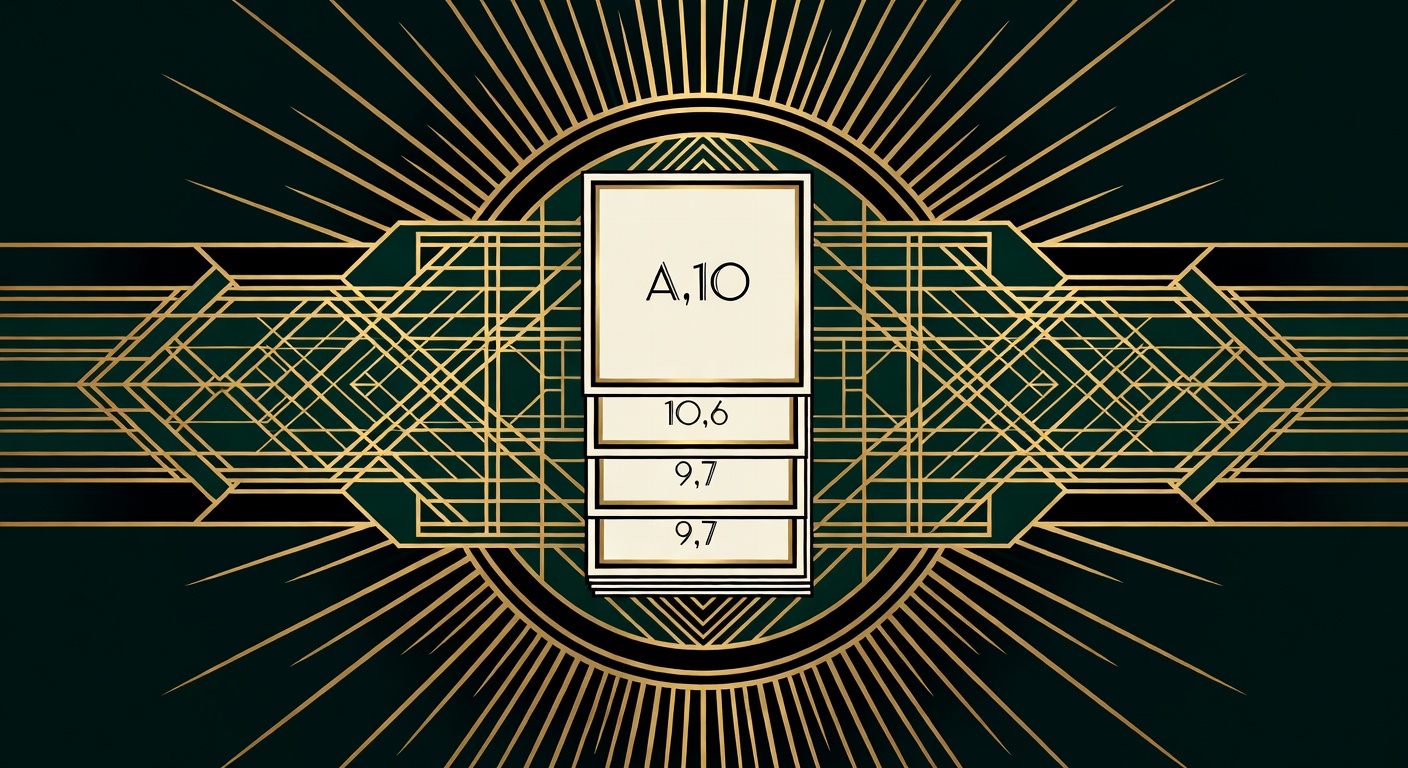
Flash cards are the standard tool in underground blackjack education. The format is simple: one side shows the player hand and dealer up-card; the other side shows the correct action. A player drills these for 20-30 minutes at a time, multiple times per week. The goal is to reach a state where the answer comes automatically, without conscious thought. This matters because in a casino, hesitation reads as uncertainty, and uncertainty triggers scrutiny from floor staff and surveillance.
The apps that replaced flash cards (Blackjack Basic Strategy Trainer, BJStrat, Casino Verite) use the same principle but with metrics. They time your responses and flag which decisions you are slow on. A professional grinder will aim for sub-second answers on 95% of decision points. The 5% of slow spots usually involve edge cases: double-hand soft 17 against a dealer 6, or whether to split 8s against a 9.
I spent weeks embedded with a group of counters in Las Vegas, and the drilling was relentless. One player, Tommy, would sit in the Aria sportsbook with a flash card app on his phone for 90 minutes before his play session started. He was not reviewing. He was warming up, the way a musician warms up before a performance. The goal was to dial in his decision-making apparatus so that during play, he could allocate full cognitive resources to counting and bet-spreading, not to remembering what to do with 15 against a 9.
The Discipline Angle
Flash card drilling serves a second purpose beyond memorization. It is a discipline filter. A player who spends 10 hours drilling basic strategy before visiting a casino has already committed psychologically. They are serious. They are unlikely to deviate from strategy under emotional pressure. A player who wings it at the table, making decisions on feeling, will leak money through strategy deviations.
Many grinders track their deviation rate. They note every hand where they did not follow basic strategy perfectly, and they review those decisions afterward. The goal is zero deviations. One top player I spoke with showed me a spreadsheet tracking 2,000 hands. He had deviated three times: once because he misread the dealer card, twice because he was tired. Each deviation cost him expected value. He was eliminating those leaks methodically.
The Software Options
Wizard of Odds Basic Strategy Trainer is free and widely used. It shows charts as you drill and provides explanation for each decision. Casino Verite is paid but includes hand histories and allows you to drill against historical sequences. Some serious players use both, using the free tool for daily warm-up and paid software for deeper analysis.
The high-end tools integrate with card-counting practice. A tool called CVCX simulates entire sessions with variable counting conditions, deck penetration, and betting spreads. It can tell you the expected value of a specific session strategy over 100,000 hands. Grinders use these to optimize their play before they ever leave the apartment.
Mobile drills are recent additions. A player can drill on the way to the casino, kill 30 minutes of waiting time with flash cards, maintain sharp decision-making. The tools measure accuracy and speed separately, because both matter. A player who answers correctly but slowly has not internalized the decision.
The Reality of the Grind
Despite all this preparation, most casual blackjack players never drill basic strategy. They play by feel, lose at a faster rate than they would with perfect strategy, and wonder why the house edge seems so punishing. The players who drill, who commit the decisions to memory, reduce their house edge from 2-4% down to 0.5%, the true house edge against perfect play. That 2% difference accumulates quickly over thousands of hands.
The flash card is a tool that fell out of fashion because we have better tools now. But the principle remains: knowledge without practice is not knowledge. Memory without automaticity is not memory. Every successful blackjack player I met had drilled basic strategy to the point where they did not have to think about decisions anymore. The decision was already made, encoded into their reflexes, ready to be executed in real time at a table.