Card counting was solved in 1962 and the casinos have been nerfing the game ever since. That is the whole history. Anyone telling you otherwise is selling a course.
Ed Thorp published Beat the Dealer in 1962. It laid out Ten Count and High-Low. Those systems, in cleaner forms, are still the systems winning players use in 2026. Sixty-four years of theoretical progress that amounts to incremental refinement of sideway count heuristics and deviations. Nothing has meaningfully displaced the core insight.
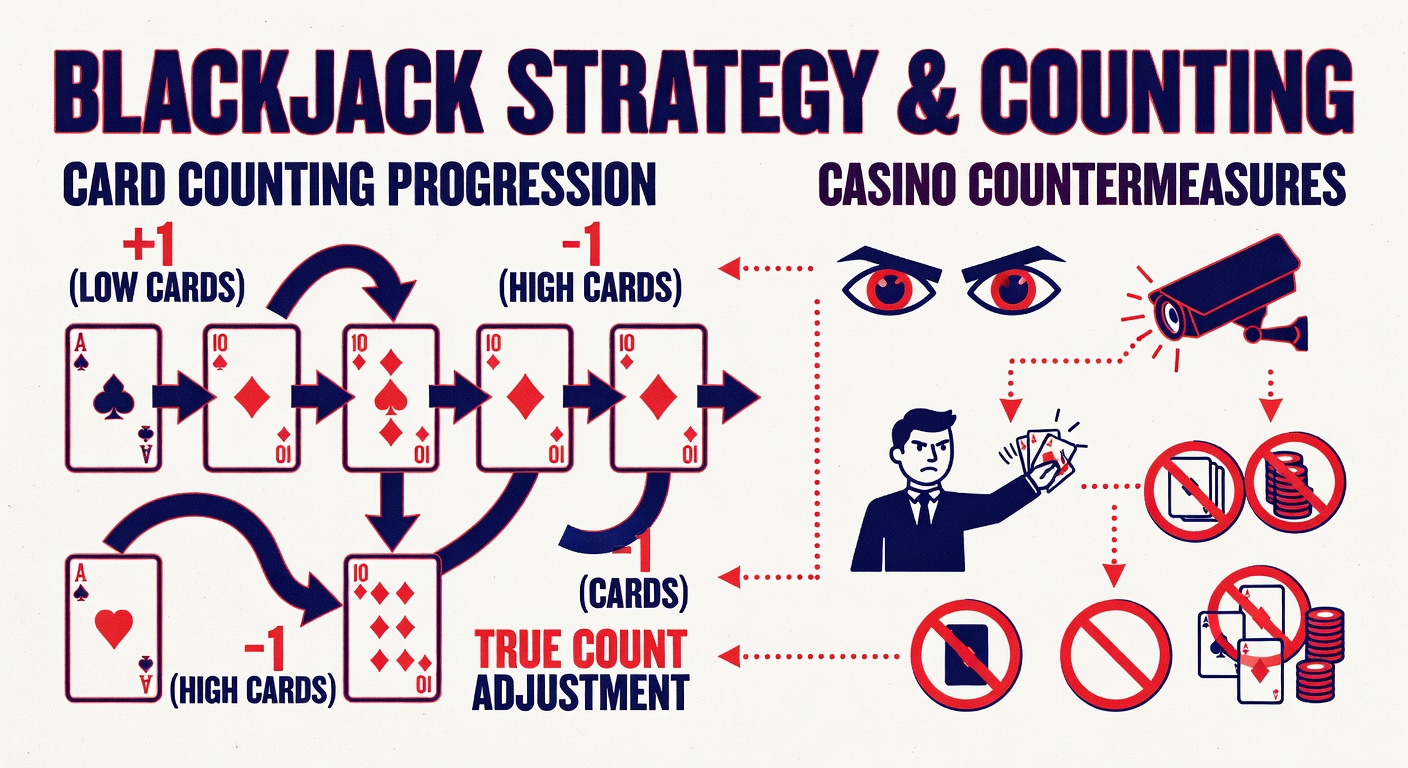
The core insight is mundane: when the remaining deck is rich in tens and aces, the player has a positive expected value, because blackjacks pay 3:2, insurance becomes correct, and the dealer busts more often on stiffs. Count the ratio of high to low cards seen. Bet bigger when the ratio favors you. Stay small when it does not.
That is it. That was the 1962 book. It is still the 2026 play. Everyone who has done real work on this since has just built sharper tools around the same frame.
The Casino Counter-Moves
The casinos did not sit still. They read the book too. Here is what happened, in rough chronological order.
1964: Las Vegas casinos temporarily change blackjack rules to neutralize Thorp's system. The rule changes are so severe that recreational business craters within weeks. The rules get rolled back within a month. Lesson learned: you cannot nerf the game too hard without killing the business.
Late 1960s and 1970s: Multiple decks. Thorp's work was on single deck. Adding decks reduces the volatility of the true count and dilutes the advantage. Most Strip blackjack moves to four decks, then six, then eight.
1970s: Deeper penetration limits. Casinos shuffle earlier, denying counters the back half of the shoe where the count information is most useful. Penetration goes from 80% of the shoe to 66% to, at the worst houses, 50%.
1980s: The MIT teams. The Uston v Resorts decision in 1982 established that New Jersey casinos could not bar skilled players solely for being skilled, but they could change the rules to make counting unprofitable. Nevada maintained the right to bar. The teams responded with disguises, tight spread discipline, and team play to circumvent surveillance.
1990s through 2000s: Automatic shufflers and continuous shuffle machines. The CSM is the single most effective anti-counter technology ever deployed. If the cards are reshuffled after every hand, the count resets to zero every hand. There is nothing to count.
2010s: Database sharing across properties. Oregon-based OSN and affiliates provide cross-casino surveillance data. A counter backed off in Atlantic City can be identified walking onto a Biloxi casino floor within minutes. The days of moving from house to house anonymously are, for serious play, over.
2020s: Facial recognition at the door. Machine learning-driven bet-spread analysis in real time. The technical infrastructure around detection has moved faster than the strategic infrastructure around counting.
What That Means for the Modern Counter
I will cut to the thesis. Counting in 2026 is not dead, but it is a side gig at best for almost everyone who studies it.
The advantage is real. Under favorable rules (3:2 blackjack, double after split, double on any two, late surrender, dealer stands on soft 17) a skilled counter using a balanced count with true-count conversion and index-play deviations can generate a player edge of roughly 0.5% to 1.5% of total action. A decent bet spread produces hourly earnings on the order of one to two average bets per hour. At $25 table minimums and a modest $25-to-$200 spread, that is $25 to $50 per hour before expenses.
Expenses. Travel. Comped rooms that require play the counter does not want to give. Tipping, which is a nonzero cost across a serious trip. Backoffs, which cost you the good game forever once the heat comes down.
You can do the math. An honest full-time professional counter in the modern era earns less than an honest full-time poker professional at the same annual commitment. The glamor is smaller. The hours are worse. The risk of being barred from every decent game in North America inside five years is significant.
The Concession
I will give the romance its due. There is a thing that counting does for a person that has nothing to do with hourly expected value, and anyone who has done it knows what I mean.
It is the only edge the casino actually cares about. Every other advantage play (hole-carding, shuffle tracking, edge sorting) is too niche to trigger the industry's institutional defense. Counting triggers it because counting scales. A single decent counter with a bankroll of six figures can take meaningful money out of a property over a long weekend, and the casino knows it.
Walking into a pit and playing a game the floor boss has been trained for twenty years to detect is, for a certain kind of player, more interesting than any other form of gambling. It is not the money. It is the game behind the game. That much I will grant.
The game behind the game is also why most serious counters wash out. The surveillance is better than you. The databases are better than you. The house has built an apparatus over six decades of practice, and you are one person with a notebook and a ride from the airport.
The Hot Take
Here is where I stake out the position that will make counting evangelists angry.
Card counting as a professional pursuit is a solved game that has been slowly regulated out of profitability, and the players who continue to grind it in 2026 are mostly doing so for reasons that are not strictly financial. Hobby. Identity. The romance of the Uston era. The feeling of outperforming a pit boss who cannot quite prove what you are doing.
Those are legitimate reasons. They are not the reasons the courses and books sell you. The courses sell you a career. The career is not there. It was there in 1965. It was thin in 1985. It is mostly gone in 2026, and the people who tell you otherwise either have not counted seriously in twenty years or are selling the course.
If you want to play blackjack, play blackjack. If you want a career in gambling, play poker or trade sports. If you want the romance of Beat the Dealer, read the book. Thorp is still in print. The math is still correct. The game is still gone.
That is the history. The rest is footnotes.