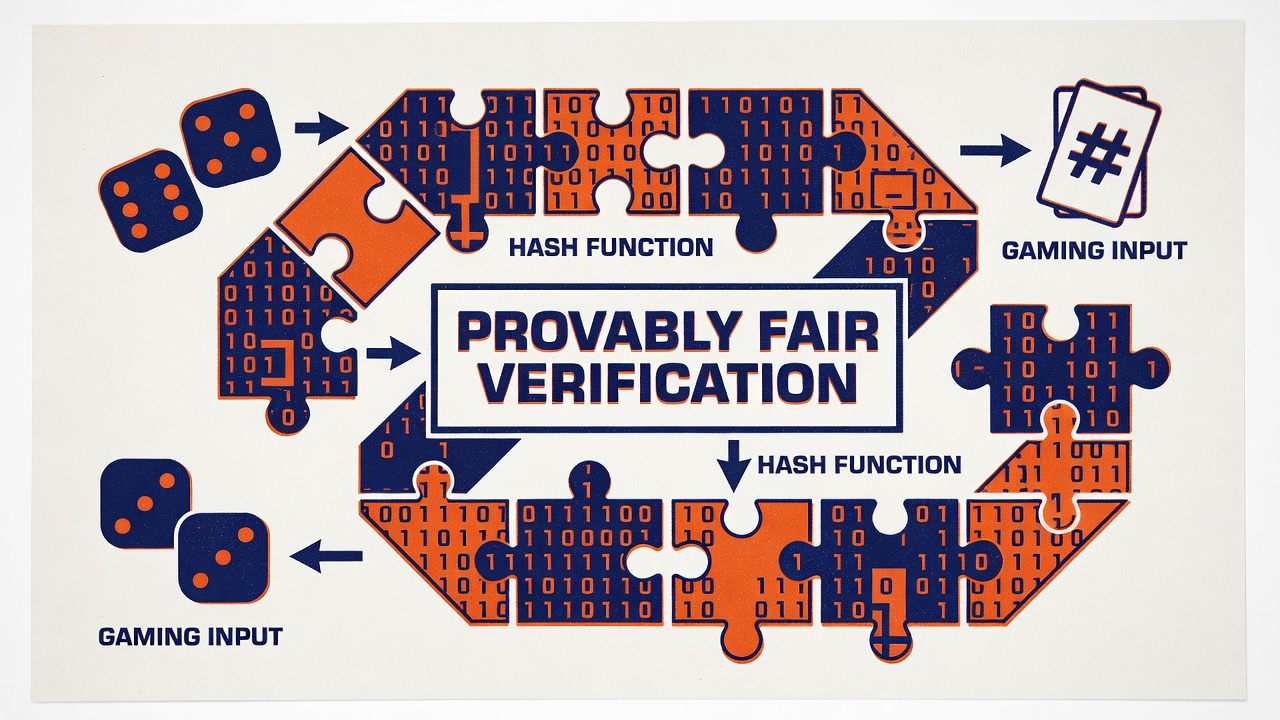
A seed hash functions as the cryptographic fingerprint of the operator's concealed seed, established prior to action initiation. You perceive the hash; the operator retains the actual seed. Upon game completion, they disclose the seed, you cryptographically process it independently, and authenticate correspondence with their announced hash. This constitutes provably fair architecture.
The foundation emerges from Bitcoin's origins. Satoshi didn't originate the concept, though Bitcoin's early ecosystem validated its soundness. Standard implementations employ SHA-256 encoding. The operator commits the hash value before wagering begins. This locks them into that seed permanently; they cannot restructure it retroactively following substantial payouts. They're permanently bound.
How It Actually Works
Logistically, the procedure operates straightforwardly in theory. The operator produces an arbitrary seed. They cryptographically transform it via SHA-256 and distribute that hash broadly. Participants observe it. Wagering commences. Game mechanics execute. Upon conclusion, operators reveal the seed. Participants transform it independently. Matching hashes indicate legitimate gameplay. Discrepancies signal operator malfeasance.
Seeds may constitute numbers, alphanumeric sequences, or entropy sources. Operators merge your bet identifier, their server seed (protected), and your client seed (controllable) to determine outcomes. On traditional slot apparatus, this generates values spanning 0 through 1,000,000. Should your outcome equal 50,000 and winning boundaries stretch from 40,000 through 60,000, you've succeeded.
Your seed component proves essential. You initialize it preceding each session. Modification remains available. Consequently, although operator RNG defects or predictability may exist, you cannot attribute disadvantageous results to their deliberate manipulation. You determined your seed. You can document non-modification throughout gameplay. This asymmetry enables the fairness guarantee.
Contrast legacy platforms, where validation depends on external auditors. Independent firms examine RNG biannually. Certification affirms "yes, randomness exists." Trust becomes mandatory. Personal verification proves impossible.
Where Seed Hashes Encounter Limitations
Provably fair methodology appears impenetrable. Reality diverges. Vulnerabilities typically originate beyond mathematics, residing within wagering parameters. Multiple weaknesses emerge:
-
Without genuine randomness in operator seeds, the infrastructure collapses. Substandard PRNGs permit deployment. You'd exhaustively test billions of prospective alternatives to discover matches. Genuine PRNGs make computational discovery implausible. Nevertheless, operators sometimes economize.
-
Client seeds deliver utility exclusively through genuine selection. Multitudes retain defaults. Maliciously programmed defaults compromise this advantage.
-
Authentication demands SHA-256 comprehension, independent execution, and cross-examination. Participants typically avoid this. They presume operator accuracy. This destroys the entire premise.
-
Vigorish persists perpetually. Fairness claims don't signify equitable probabilities. Titles become provably fair yet sustain 5% vigorish. Operators profit while maintaining technical honesty.
Seed Hash vs Merkle Trees
Merkle configurations provide alternatives. Operators pre-construct trees containing 1,000,000 prospective outcomes. Results function as leaves. Operators distribute the foundational hash. Participants select numbers spanning 1 through 1,000,000. Operators furnish pathways from participant leaf to foundation. Participants authenticate cryptographic chains. This involves fractionally increased complexity versus seed hashes yet precludes operators from restructuring results retroactively across batches.
Merkle implementations dominated BitStarz and Pocketdice. Seed hashes dominate modern platforms. Neither demonstrates absolute superiority. Merkle permits full upfront authentication. Seed approaches validate individually. Selection depends on preferences.
Why Authentication Matters
Provably fair exists through verification capability. Realistically, you probably won't authenticate. Most participants never attempt it. However, substantial payouts justify demanding substantiation. You independently transform seeds, authenticate against published values, and reach definitive conclusions regarding operator honesty.
Regulated establishments (UK, Malta, Curaçao, etc.) cannot implement this methodology. Jurisdictions mandate external authentication exclusively, precluding participant verification. US and EU participants' operators might withhold hash information entirely.
Crypto platforms employ differing approaches. Certain entities emphasize it prominently. Others demonstrate indifference. Examine terms carefully. Request hashes prior to gaming. Reluctance or inability signals inauthentic fairness claims. They're distributing concepts, not verifiable mechanisms.
Underlying infrastructure functions genuinely. Economic incentives drive adoption, as operator authentication costs less than external auditing expenses. However, mutual participation determines actual utility. Mathematics ignores whether participants authenticate. The commitment remains only valuable when implemented by both parties with integrity.