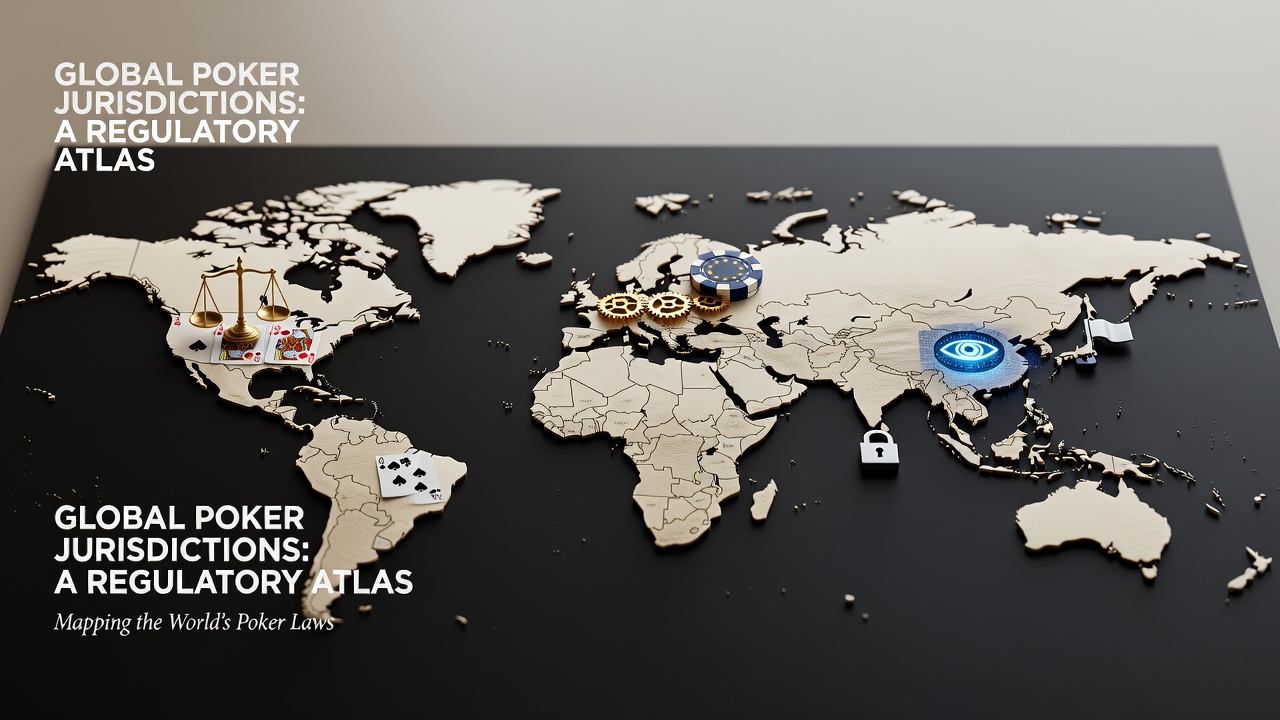
Poker regulation reads like a geopolitical thriller written by actuaries. Different countries have reached different conclusions about whether poker is a game of skill (largely unregulated) or a game of chance (heavily regulated) or some hybrid requiring specific licensing. The pianist in a Monte Carlo back room might be perfectly legal in one jurisdiction and criminal in another. The distinction mattered before online poker. Now it's theological.
Here are the frameworks.
The United States: A Thousand Different Rules
The federal government does not regulate poker directly. It left that to the states. Nevada licensed casinos in 1931 and has been managing poker ever since. Poker was cordoned off as a card room game, separate from table games. You needed a license to operate. Players did not. California established its own system in the 1990s. The state allowed poker rooms to operate under strict licensing but did not tax them at the same rate as casinos.
A few states declared poker illegal. Texas, for instance, had a long period where home poker games were actually prosecutable. South Carolina made it challenging for card rooms to operate. Other states ignored it entirely. The result: a fragmented landscape where a poker game legal in Nevada is technically illegal in Texas, even if nobody is actually prosecuting home games there.
Online poker exists in an even stranger space. Federal law (the Unlawful Internet Gambling Enforcement Act of 2006) doesn't explicitly forbid poker online. It forbids using payment systems to fund illegal gambling. States interpret that differently. New Jersey and Pennsylvania have explicit online poker licensing regimes. Most other states have ambiguity.
The United Kingdom: Skill-Based Model
The UK Gambling Commission treats poker as a game of skill. This matters. Games of chance require gambling licenses. Games of skill do not (or require a different category of license). The Gambling Commission determined, in the early 2000s, that poker's skill element outweighed its chance element. This opened the door for poker rooms to operate with minimal oversight.
The reasoning: if you're good enough, you can be a professional poker player and earn income. A professional gambler wouldn't exist if poker were entirely chance-based. The existence of professional players (documented by income records, sponsored players, etc.) proves the skill component.
This framework allowed PokerStars and other platforms to operate legally in the UK for years. It attracted professional players from around the world. Europe became a poker hub partly because the UK's position filtered down to other jurisdictions.
Malta and Europe: Licensing Everything
Malta (under the Malta Gaming Authority) created a licensing regime that treats poker as a regulated gambling product. You get a license, you operate under strict rules (player protections, responsible gambling measures, anti-money-laundering requirements). The license is expensive and comes with obligations.
The upside: legal certainty. You know exactly what the rules are. You know your players are protected. You know regulators are checking your RNG and your financial controls.
The downside: cost and complexity. A Malta poker license can run six figures annually. This is why operators consolidate. One operator gets the license and multiple brands operate under it. GVC Holdings operates PartyPoker and PokerStars (after recent re-licensing) under similar frameworks.
France and Australia: The Restrictive Model
France created a licensing regime for online poker but under a state monopoly framework for certain games. Poker is allowed but only under specific conditions. You need a license. You have to use a French server. You can't operate across borders. This protects French players (allegedly) and protects the French government's revenue.
Australia is harsher. Online gambling is technically illegal for Australian operators. This doesn't stop operations, but it means operators are operating without licenses. The legal status is murky. Players can access overseas sites legally (Australia hasn't criminalized being a player), but operators are on uncertain legal ground.
The Asia-Pacific Tangle
Singapore is heavily restricted. Macau is poker-friendly (it's a casino jurisdiction). Philippines, Cambodia, and a few others have liberal licensing regimes and have attracted operators looking for legal safety. The tradeoff: less regulation, more risk that the government changes its mind.
The Pattern
Countries that view poker as skill have lighter-touch regulation. Countries that view it as chance have tighter licensing. The distinction hinges on whether the jurisdiction values tax revenue (licensing is lucrative) versus player protection (licensing requirements can be extensive). There's no universal standard. A room licensed in Malta might not be legal in Italy. An operator licensed in Nevada can't legally accept players from most other U.S. states.
The result is that professional poker players have to navigate a patchwork of jurisdictions. They play where they're licensed. They pay taxes accordingly. Or they play unlicensed games and accept the legal risk. The regulation hasn't eliminated poker. It's just made it more complicated for the people who want to do it professionally.