Rake is the way online poker rooms make money. Every pot has a percentage or a cap removed before the winner collects. A $100 pot becomes $95 because the house took $5. This is not a theory. This is how the business operates. The economics are straightforward: if the rake is too high, players stop playing. If it is too low, the site loses money. The sites find the balance point where they maximize total rake revenue without killing the game.
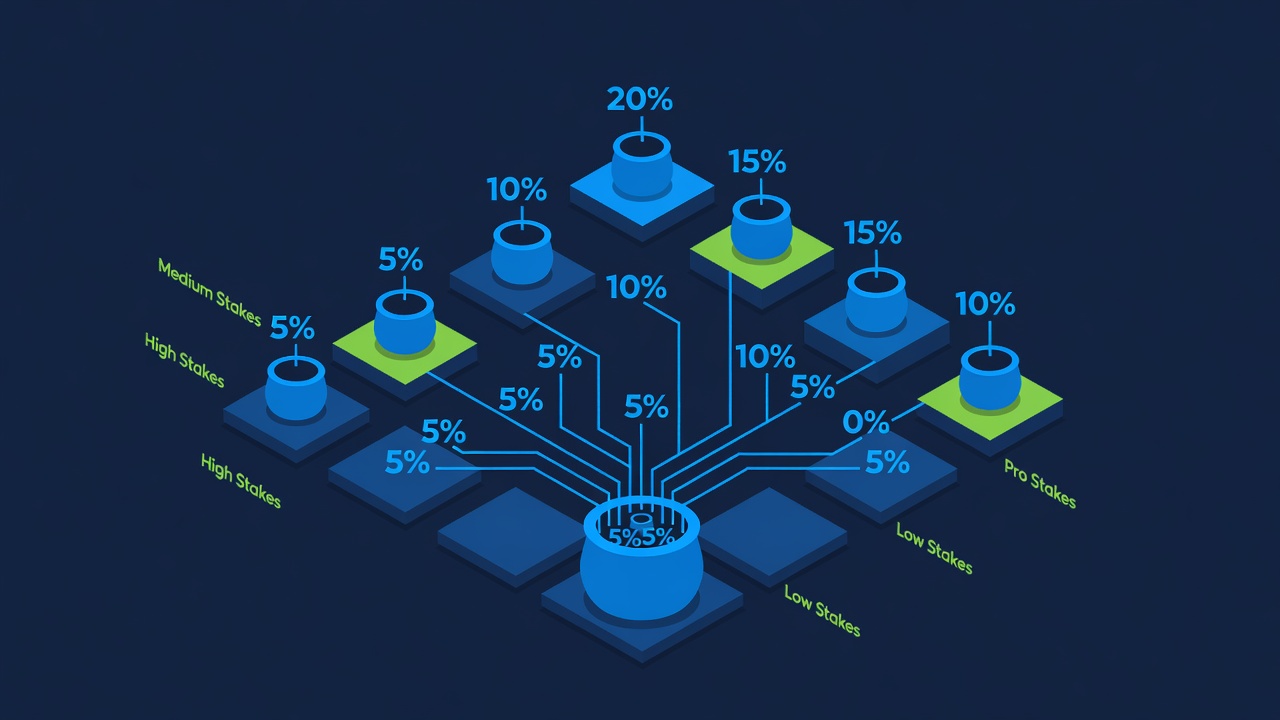
Online rake structures vary by stakes and format. A typical limit-bet game at PokerStars takes 3-5% up to a $3 cap. A no-limit cash game takes 5% up to a $4 cap. High-stakes games sometimes have lower rake as a percentage because the absolute dollars are already high. A Spin and Go tournament takes roughly 10% in rake and provider fees. These are not trivial percentages when you consider how many hands you play per hour.
The Math of Small Percentages
Suppose you play 30 hands per hour in a $1-$2 game. You win an average of $3 per hand before rake. After rake, the actual number is closer to $2.70. That is a 10% reduction in your hourly rate. This does not sound catastrophic until you do it 200 times per week for 50 weeks per year. You are playing 300,000 hands annually. A 10% reduction is meaningful income loss.
This is the distinction between room expectancy and player expectancy. A player might have positive expectancy in theory, generating +$3 per hand. The room then takes its cut. The player's actual expectancy becomes +$2.70. A mediocre player with zero expectancy gets crushed by rake. Every hand they lose, they lose slightly more than they would at a physical casino because the rake removes money from the total pot.
Rake Structure and Decision Making
Rake affects strategy beyond just the numbers. Rake incentivizes the site to run more tables with more players sitting out, because every table generates rake regardless of whether the game is soft or competitive. Some sites have stopped offering heads-up cash games because the rake was harder to extract with only two players generating pots. A $100 pot with two players and 5% rake is $5. That same $100 pot split among six players is still $5, but spread across six hands, it is not worth the server costs.
Rake also incentivizes loose, aggressive play. Games with more hands dealt generate more rake. A tight, patient table with smaller pots generates less rake than a loose game with big pots and frequent all-ins. This means the site subtly encourages wild play through incentive structure. The rakeback programs they offer are designed to keep players in high-volume formats, not high-winrate formats.
Comparison to Live Play
A live casino charges rake similarly but operates with slightly different economics. A live poker room at the Bellagio in Las Vegas charges $4-$6 per hand in time collections. You pay this whether you win or lose. Some rooms use a percentage rake on certain games. The rake is still coming, but it is visible. A $3 time collection on a $1-$2 game is roughly equivalent to 5% rake. But because you pay it per hand regardless of pot size, players become acutely aware of the cost.
Online rake hides inside the pot. You never see a separate deduction. You simply see the pot get slightly smaller before it moves to the winner. This psychological difference matters. Players lose track of how much rake they are paying because it is diffused across hundreds of hands. The cumulative effect is the same as a time collection, but the player experiences it as less painful.
Rakeback and Affiliates
Top players negotiate rakeback with rooms, getting 25-40% of the rake they generate returned to them. This is the inside game that recreational players never access. If you are a mid-stakes player generating $5,000 per month in rake and you have zero rakeback, you are paying full freight. If you have 35% rakeback, that $5,000 becomes $3,250. This is effectively a 23% increase in hourly rate.
Affiliates also exploit rake. An affiliate brings players to PokerStars and gets paid 30-50% of the rake those players generate for the first 60 days. Then the affiliate loses access and PokerStars captures the remainder. This model incentivizes affiliates to recruit high-volume players, not skilled players. A losing recreational player might generate more rake in 60 days than a skilled player would, making them more valuable to the affiliate.
The truth about rake is simple: it is a silent tax on your poker income. A 2% skill advantage in the game combined with 5% rake removal means you are net-neutral or negative. Only players with substantial skill edges, who can generate +8-10% expectancy, can overcome rake and build real bankrolls. Everyone else is slowly transferring money to the site every hand they play.