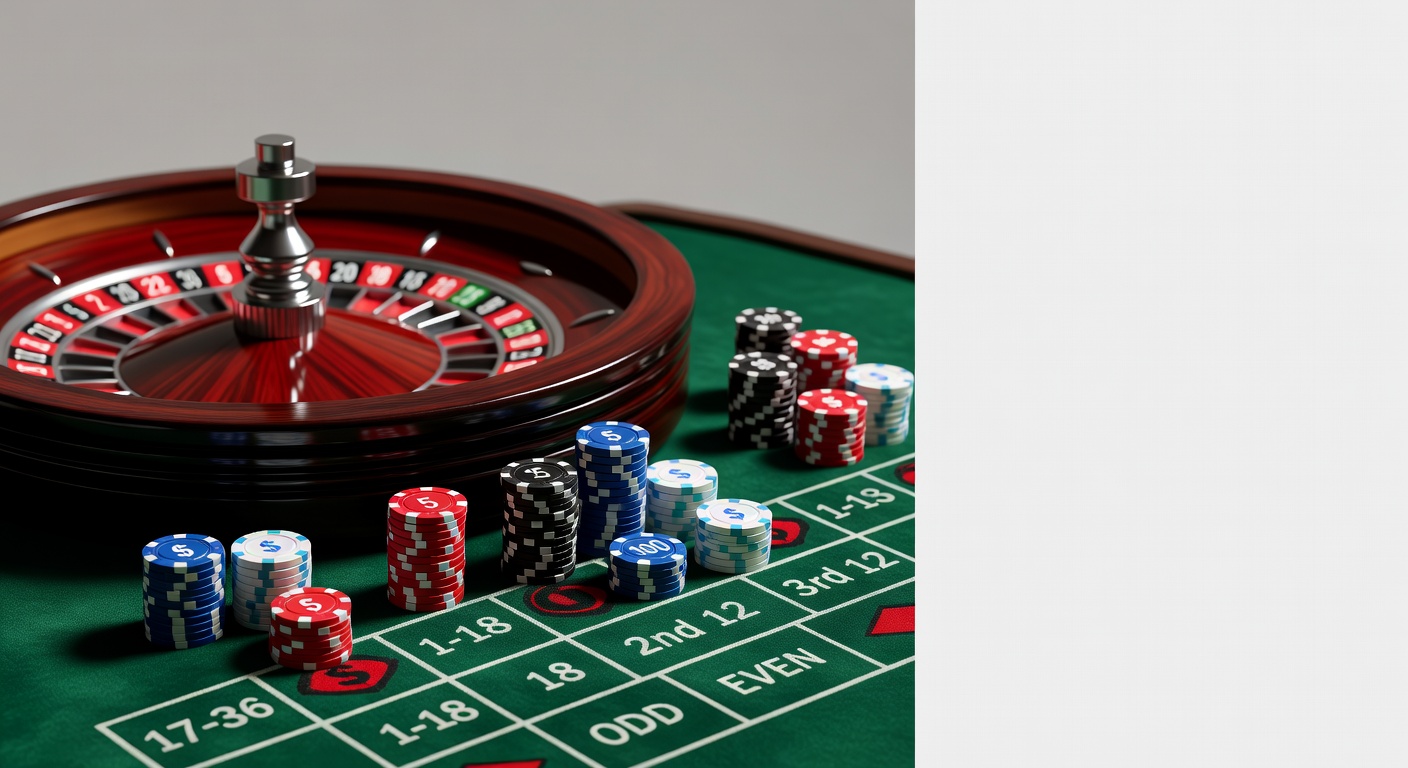
You're watching a live roulette stream. Seventy-three in a row, red hasn't hit. Your system says: now is the time. Red is due.
Red is not due. Red has a 48.6% chance this spin, same as every other spin. The fact that it hasn't hit for 73 spins changes nothing about this spin.
But there's money in telling you otherwise.
Why Systems Fail
Roulette is a game with a house edge of 2.7% (European wheel) or 5.26% (American wheel). This edge exists because the payout doesn't match the true probability. A red/black bet pays 1:1 but has 48.6% odds.
No system removes a negative expectation. No progression of bets, no reverse progression, no counting systems, no computer analysis changes this math.
A system might redistribute risk: you might win three small bets and lose one large bet, breaking even, when random play would have you grinding slowly down. But the grind is what the house wants. The system just tries to short-circuit it.
The math doesn't care about your system.
The Martingale Trap
Double your bet after every loss. Lose once, bet 2. Lose again, bet 4. Lose again, bet 8. When you win, you've made back all losses plus one unit.
On paper: perfect.
In reality: you need unlimited bankroll and unlimited table limits. After 7 losses in a row (happens roughly 1 in 128 times), you're betting 128 units to win 1.
After 10 losses in a row (happens roughly 1 in 1,024 times), you need 1,024 units to win 1. Most people don't have that. Most casinos won't let you bet that. The system breaks.
The D'Alembert Scam
Increase your bet by one unit after a loss, decrease by one after a win. It feels gentle. It sounds mathematical.
It's still a losing system. It just loses slower and feels better while doing it.
What Actually Happens on Live Roulette
You see the results. Eight reds, two blacks. Your system says: blacks are underrepresented, bet black.
But you're seeing sample variance. In 1,000 spins, perfect probability says 486 reds, 486 blacks. In 10 spins, you might see 8 and 2. That's normal. Your system is betting on normal distribution to keep happening, but probability doesn't work that way.
The Dealer Tells
Some people think live dealers have tells. If they spin from the same position, the ball lands in a predictable zone. If they release the ball at the same speed, you can predict the outcome.
Roulette manufacturers specifically designed wheels to be impossible to predict. The European wheel has 37 pockets. The numbers aren't in order around the wheel. Black and red alternate deliberately. The whole machine is built to prevent pattern recognition.
A live dealer might have slight variations in technique, but the wheel compensates. The ball might have wear. That's randomness too.
Why This Matters
If someone is selling you a roulette system, they're not using it themselves. They're selling it to you.
A professional gambling operator doesn't share edges. If the system worked, they'd use it. Instead, they're pricing it at $39.99 and selling it to 10,000 people.
If 10,000 people use the system and 8,000 lose money, the system vendor made $315,000. The players lost $400,000. The casino made $100,000. Everyone made money except the people who bought the system.
What Works Instead
First, understand that you cannot beat a fair game. The house edge on roulette is fixed. Accepting this is 80% of the mental game.
Second, if you're going to play roulette because you enjoy roulette, set a loss limit. Say "I will spend $100 per session." Divide by the expected house edge. At 2.7% on European roulette, you expect to lose $2.70 per session. That's your entertainment cost.
Third, take advantage of live roulette bonuses if they exist. Sometimes a sportsbook will offer $50 free to play live roulette. That $50 has a 48.6% chance of becoming $100 (if you go all-in on red or black). It has a 51.4% chance of becoming $0. Both outcomes are fine because the $50 was free.
Fourth, understand your time value. If you're going to sit and watch a roulette stream for two hours, that's two hours of entertainment. If you enjoy it for $200 down, that's $100 per hour of entertainment. Some people love that deal. Some people think that's insane. Know which person you are.
Fifth, never borrow money to bet roulette. Never chase losses. Never go "double or nothing" to recover. These are the tells of someone whose brain is broken by gambling.
The Hard Truth
Roulette is a game the house is mathematically guaranteed to win over time. A system doesn't change this. A system just helps you lose faster or slower.
Choose slower. Set limits. Enjoy the game for what it is: a random outcome generator that pays the house its edge over time.
Anyone telling you otherwise is selling something.