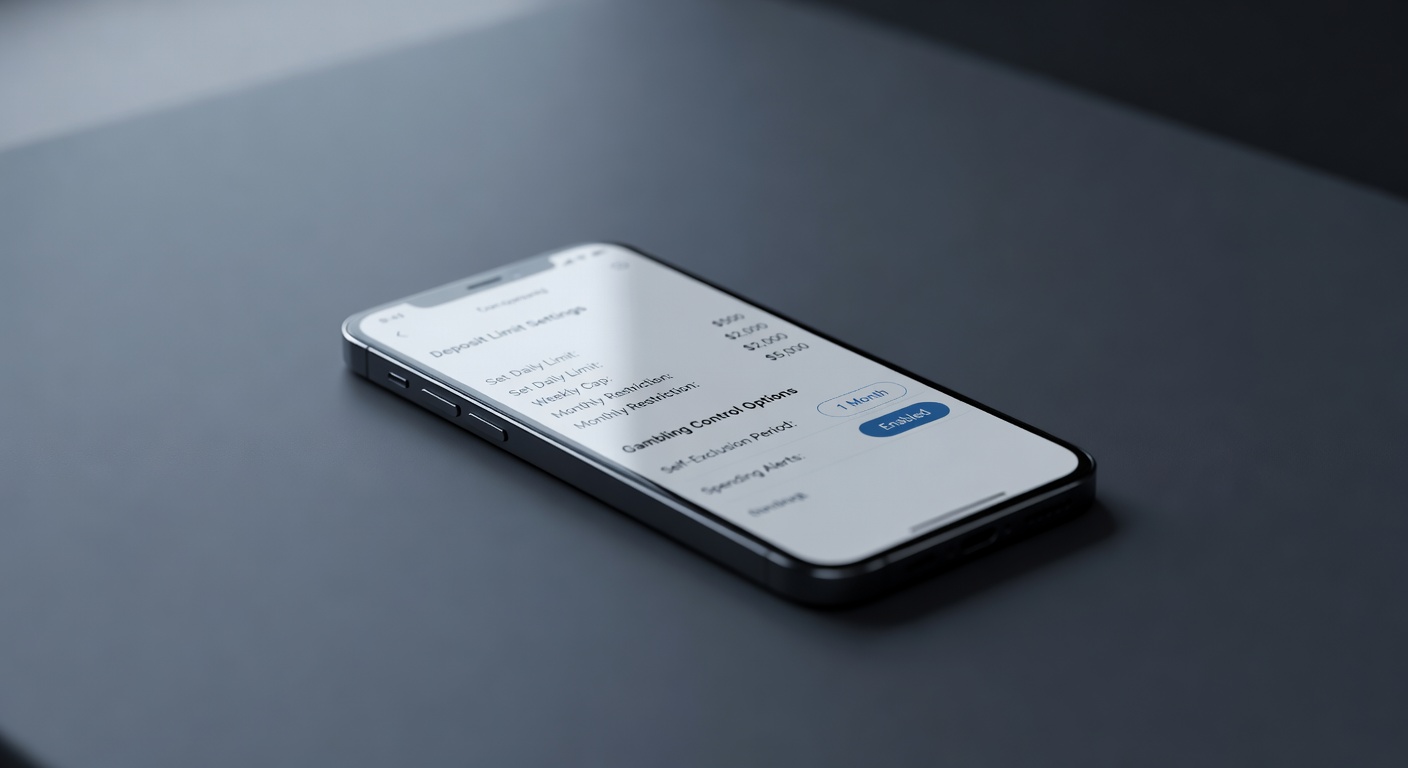
A responsible gambling tool is a feature that lets you limit yourself. Deposit limit: you can't deposit more than $100 per day. Time limit: after 60 minutes, the game closes. Self-exclusion: you can't access your account for 6 months.
These are built into every licensed mobile casino. They're required by regulation in most jurisdictions.
Most players don't enable them.
Why
Psychologically, enabling a limit feels like admitting you need help. Players think: I'm in control. I'll stop when I want.
Then they lose $2,000 in a weekend and wish they'd enabled the $200 daily limit.
Enabling limits isn't about admitting you're a problem gambler. It's about giving future-you a tool that present-you consents to.
How It Works on Mobile
Most apps have a menu: Account Settings, Responsible Gaming, or similar.
You set your limit. Daily deposit limit is common: $50, $100, $500, $1,000. Pick one.
Time limit: 30, 60, 120 minutes per session. After the timer expires, you're logged out.
Self-exclusion: temporary (6 months) or permanent (forever). During exclusion, your account is frozen. You can't deposit or play.
The Mechanism
The app enforces the limit on the client side. If you set a $100 daily deposit limit and try to deposit $200, the app blocks it.
That's simple. What's harder: the casino also enforces it server-side. Even if you somehow modify the app (jailbreak your phone, hack the code), the server will reject deposits that violate your limit.
What Regulators Require
UK Gambling Commission requires all licensed operators to have "safer gambling tools" available and easy to access.
The tools must be easy to enable (not buried in a menu). Must be easy to adjust (increase or decrease limits). Must be easy to use (one-button self-exclusion).
If an operator makes these tools hard to find, regulators fine them.
Why Players Don't Use Them
First, denial. "I don't have a problem."
Second, hope. "Maybe this time I'll win and I won't need the limit."
Third, pride. "Admitting I need a limit means I'm weak."
Fourth, friction. If the tool requires three menu clicks to enable, most people don't bother.
Licensed casinos reduce friction by making tools easy. But unlicensed casinos (crypto, offshore) often don't have these tools at all.
The Data
Studies on responsible gambling tools show mixed results. Deposit limits reduce spending. Time limits are less effective (people just turn them off). Self-exclusion works (people don't gamble if they're excluded).
Overall, players who enable limits lose less money. Not zero money. Less money.
What to Do
Enable a deposit limit today. $50 per day if you earn $40K/year. $200 per day if you earn $100K/year. The number doesn't matter. Having a number matters.
Enable a time limit: 90 minutes per session. That's three poker hands, five blackjack hands, thirty slot spins. Reasonable amount.
Enable notifications at 80% of time limit. This gives you a warning before the session closes.
If you're serious: enable self-exclusion for 6 months. Not because you're desperate. Because you're taking the game seriously.
After 6 months, reassess. Did you miss gambling? Did you lose money when you did play? Make a decision about the next 6 months.
The Hard Truth
Responsible gambling tools are built for the 5% of players who are or will become problem gamblers. The other 95% don't think they need them.
But the 5% think they don't need them either, until it's too late.
Self-awareness is bad at predicting future behavior. A tool that removes the choice is better than a choice you have to make while emotional.