Hughes checked in November 27, 1966. He never left the ninth floor.
He booked the entire floor through his representatives. Penthouses, suites, the working rooms. Nobody else was allowed up. He arrived by train from Boston. He was fifty-nine. He was carrying a billion-dollar fortune, a near-total phobia of germs, and a six-foot frame that had been reduced to roughly ninety pounds by years of eating the same prepared foods and injecting the same codeine solution.
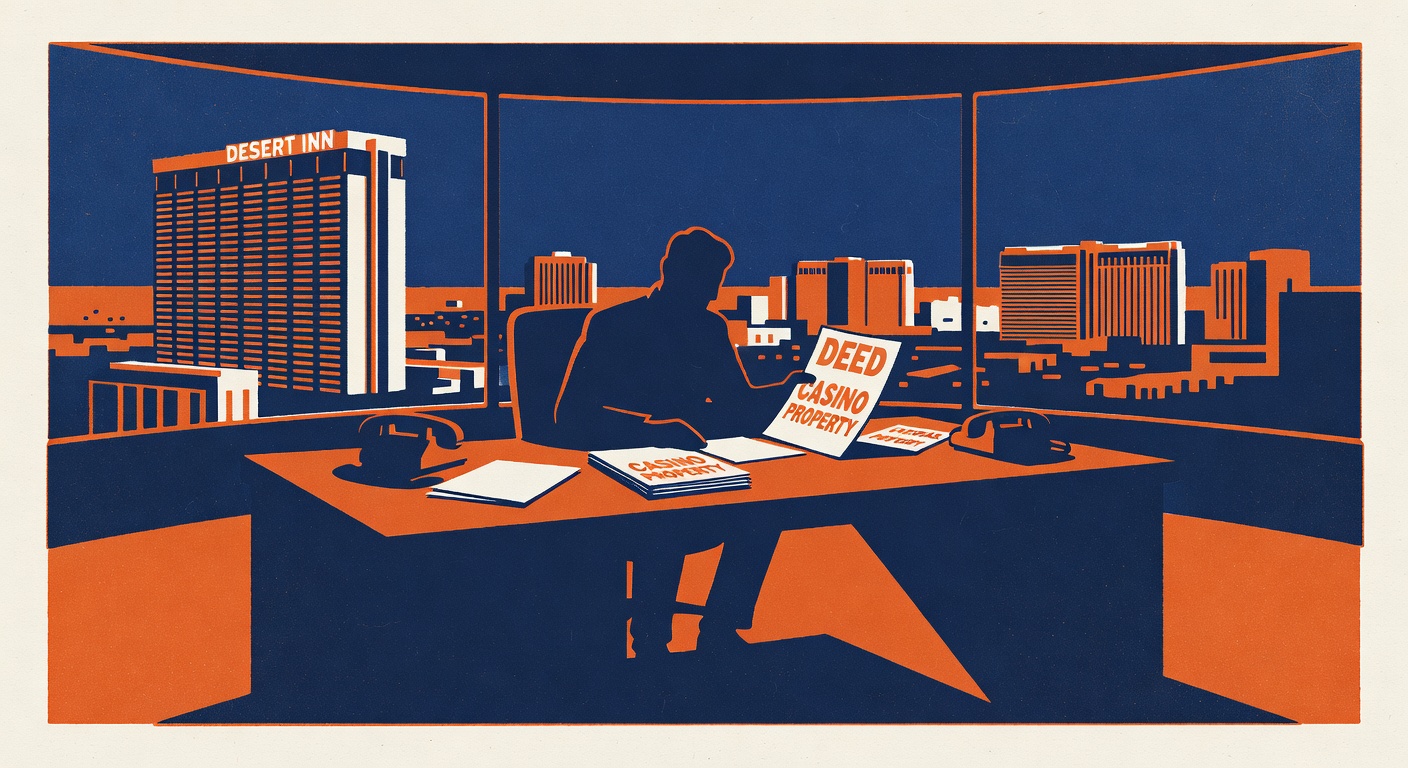
The Desert Inn was owned by Moe Dalitz. Dalitz was not sentimental. The Desert Inn had a New Year's Eve schedule and the hotel's high-rolling regulars had reservations. Hughes had booked for ten days. Ten days passed. Hughes did not leave. Dalitz's representatives asked him, via the Hughes aides who shuttled notes between the ninth floor and the lobby, to vacate the floor.
Hughes refused.
Dalitz gave him a deadline. March 1, 1967.
Hughes bought the hotel instead. Thirteen million dollars, cash.
The Eight Properties
This was not a one-off. Hughes bought the Sands two months later. Fourteen million. The Frontier, in July. The Castaways. The Silver Slipper, which he bought specifically to turn off its rotating neon sign, which he could see from his suite window and which was keeping him awake. Harold's Club in Reno. The Landmark Hotel, whose 31-story tower he acquired in 1969 to complete its construction, which had stalled under the previous owner.
All told, between late 1966 and late 1969, the Hughes Tool Company acquired eight casino-hotel properties in Nevada for a total of approximately three hundred million dollars.
This was roughly 17 percent of the state's total casino capacity at the time.
Why This Mattered
It mattered because of who he was and who he was not.
He was not the mob. That was the point. The Nevada Gaming Control Board, chaired at the time by Ed Olsen, had spent a decade trying to find publicly-traded corporate ownership that could displace the syndicate money that had funded Las Vegas since Siegel and Lansky. The Kefauver hearings in 1950 had put Nevada on notice. The 1959 Nevada Gaming Control Act had given the state the legal tools. What was missing was the money willing to come in.
Hughes was the money.
He was also, for Nevada's purposes, unusually convenient. He was reclusive. He was not going to appear in front of the Gaming Control Board. He was not going to make public statements. He was not going to take action. His representatives could negotiate with the state on his behalf, and the state could cite his ownership in testimony before federal committees as evidence that the industry was moving toward respectability.
Nevada waived the personal licensing requirement for Hughes in early 1967. This was the first time the state had granted a casino license without requiring the owner to appear personally. The precedent established by this waiver would be used, repeatedly, over the following two decades to allow publicly-traded corporations to own Nevada casinos without every board member being individually licensed. Kirk Kerkorian's International Leisure, Del Webb's entry into the Sahara, the eventual acquisitions that became Caesars World, all traced back, in terms of regulatory precedent, to the exception made for Hughes.
What He Actually Did
Here is where it gets strange. Hughes, having acquired roughly a sixth of the Strip, made almost no operational changes to any of the properties.
He did not visit the casinos. He did not walk the floors. He did not meet with the pit bosses or the shift managers. He issued instructions via handwritten memos delivered by his Mormon aides, known around Vegas as the Mormon Mafia because of their religious background and their fierce personal loyalty. The memos dealt with trivial matters: the volume of music in the hotel lobbies, the brand of cigarettes sold in the gift shops, the color of a carpet he had seen in a photograph sent to his suite.
He did not fire the incumbent management. Moe Dalitz continued to run the Desert Inn. The existing floor operations continued largely unchanged. The mob pit bosses remained pit bosses. The skim, which federal investigators later estimated at hundreds of millions of dollars across the 1960s Strip, may have continued on a reduced basis under the new ownership, though the documentation of this period remains contested.
What Hughes accomplished, mostly without knowing he was accomplishing it, was the political legitimation of the industry. A publicly-traded corporate structure owned by a recognized American billionaire made Las Vegas acceptable to institutional investors and federal regulators in a way that no amount of Nevada-side cleanup could have.
The Departure
Hughes left the Desert Inn on Thanksgiving night, 1970, exactly four years after he arrived. He was carried out on a stretcher. He was moved by private plane to the Bahamas, and from there to Nicaragua, Canada, Mexico, and eventually London. He never returned to Nevada.
He died on April 5, 1976, on a jet flying him from Acapulco to a Houston hospital. He weighed ninety pounds. His fingernails had grown to several inches. His medical records showed kidney failure and dehydration, among other conditions.
The casino properties he had assembled were, by that point, operating as a recognized holding structure under Summa Corporation. They would be sold off piecemeal over the following fifteen years. The Desert Inn itself was eventually acquired by Steve Wynn in 2000 and demolished in 2004 to make room for the Wynn Las Vegas.
What the Story Tells Us
This is not a story about a great gambler. Hughes gambled almost not at all. By the few accounts of his behavior in Vegas that can be verified, he never placed a bet.
It is a story about an industry that needed exactly one thing at exactly one moment, and got it from a man who was not looking to provide it.
The Strip was trying to launder its own history. Hughes, in the process of barricading himself into a hotel room for four years, handed it the laundering by accident. Nevada licensed him. Nevada waived its rules. Nevada made the precedent. And the precedent became the legal architecture on which the modern corporate gambling industry was built.
The skim did not disappear immediately. The mob did not leave all at once. But the direction changed. The direction changed at the moment a reclusive billionaire, refusing to vacate a penthouse, bought the penthouse instead.
It is the only story I know in the history of American gambling where a man did nothing on purpose and changed the shape of an entire industry as a side effect.
That is the job, sometimes. Not the play at the table. The presence, and the name, and the thirteen million dollars cash.