The mechanical slot machine that appeared in San Francisco saloons in the 1890s offered a single payout structure: win or lose. By the 1960s, when electromechanical slots became standard, manufacturers began experimenting with networked machines that could pool funds across multiple units. This innovation created a new category: the progressive jackpot. Understanding the distinction between fixed and progressive slots requires examining both the mechanical history and the economic incentives embedded in each design.
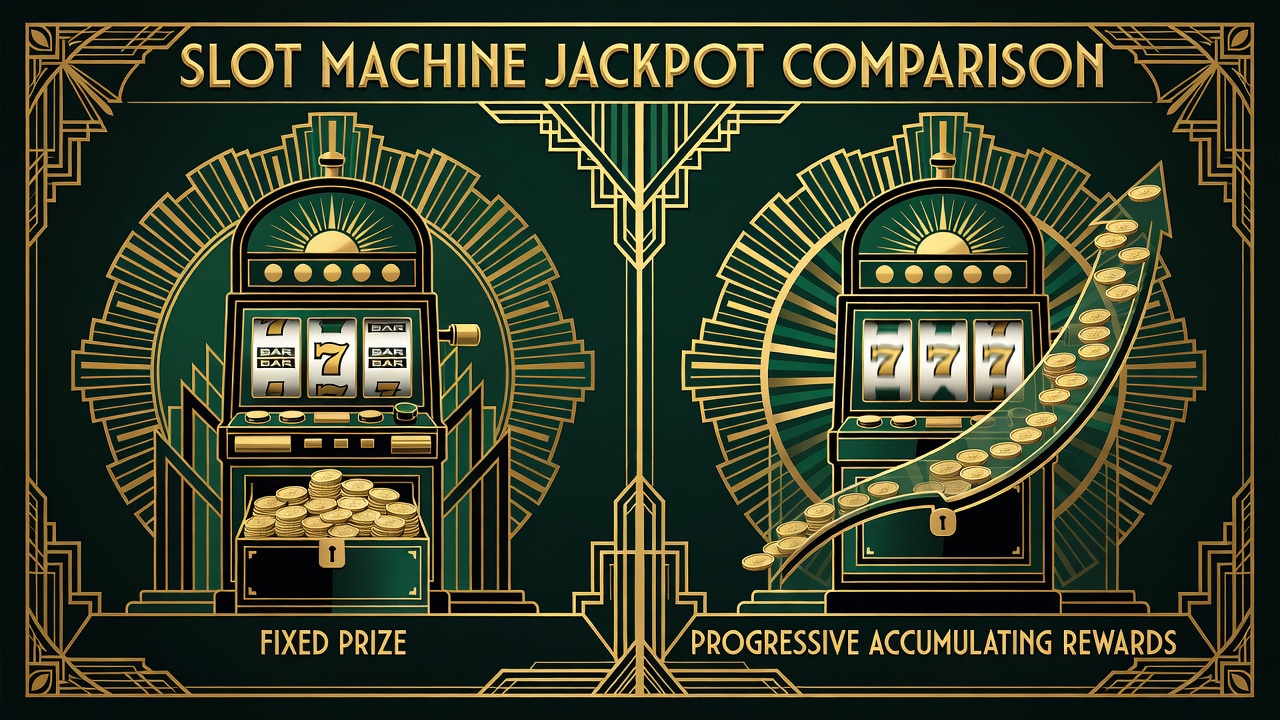
A fixed jackpot slot offers predetermined maximum winnings. A Liberty Bell machine manufactured by Charles Fey in 1895 paid out ten cents for three bells on the payline. The maximum payout was fixed. The player's expected value was identical regardless of when they played. The house edge remained constant.
A progressive jackpot slot accumulates a portion of every wager across multiple machines. When one player wins, the pool resets. This structure emerged in the 1960s when slot manufacturers realized that the possibility of a life-changing payout could increase play volume and machine floor placement. The International Game Technology company pioneered networked progressives in 1986, connecting machines across entire casinos.
The Structural Difference
Fixed jackpot slots allocate payout percentages as follows: a small percentage of wagers fund base game payouts, a separate percentage funds the house, and a fixed amount funds the maximum jackpot. The machine's internal mechanism ensures that the fixed jackpot is included in the payout percentage. A fixed jackpot of $5,000 on a machine set to return 92% means that all winnings, including the jackpot, comprise that 92% theoretical return.
Progressive jackpot slots operate differently. The base payout percentage (typically 85-91%) funds regular wins. An additional percentage of each wager funds the progressive pool. The house still maintains its edge, but the maximum win is theoretically unlimited, since the pool grows with every spin across all connected machines.
This distinction has mathematical consequences. A fixed jackpot slot offers the player identical odds on every spin, with a fixed house edge. A progressive slot offers the player variable odds depending on the current jackpot size. When the progressive pool reaches $1 million, the player's expected value improves compared to when the pool sits at $200,000. This property creates a known phenomenon: players wait for progressives to reach threshold values before playing.
The History of Scale and Incentive Structure
Mechanical progressives appeared first in physical form. Casinos placed machines in a linked format, connecting mechanical components across multiple units. When any machine hit the jackpot, electromechanical systems would reset all connected machines simultaneously. This technology was expensive and prone to malfunction.
Electronic progressives solved the reliability problem. Computer networks allowed casinos to track contributions and payouts instantaneously. The software could generate the appearance of a shared pool without requiring physical connection. By the 1990s, wide-area progressives (machines across multiple casinos, sometimes statewide or across state lines) became viable.
Wide-area progressives fundamentally changed the player psychology. A machine connected only to its local casino might accumulate a $50,000 pool. A machine connected to a statewide network might accumulate a $5 million pool. The larger pool attracted players who had no intention of playing slots but wanted an improbable chance at a massive prize.
The Economic Model
From the operator's perspective, progressives serve a specific function: floor placement and machine density. A casino can place more progressive machines and justify the floor space because the growing jackpot generates steady play volume. Players engage with the game longer on average because they chase the accumulating prize.
Fixed jackpot slots require the operator to maintain consistent payout percentages through careful return-to-player (RTP) calibration. A casino setting a fixed jackpot must ensure that the total payout (including the jackpot) does not exceed the intended return percentage.
Progressives offer flexibility. If a progressive is not performing, the casino can lower the contribution percentage or raise the house edge on the base game. The jackpot automatically adjusts upward more slowly. This adjustment mechanism is invisible to the player but measurable in revenue terms.
The Odds Comparison
A fixed jackpot slot offers transparent mathematics. The machine's theoretical return is published. A player knows that every spin on a machine set to return 94% offers identical expected value. The house edge remains 6%.
A progressive slot's mathematical advantage shifts with jackpot size. When the pool is small (recently reset), the base payouts represent a larger portion of total potential return, and the house edge is high. As the pool grows, the house edge decreases. At extremely high pool levels, the mathematics can tip: the expected value of the progressive game can approach or exceed the player's stake (though this never occurs in practice because casinos adjust the contribution percentage before this point).
Regulatory bodies (the Nevada Gaming Control Board, the UK Gambling Commission, and others) require operators to publish the theoretical return percentage and the contribution rate for progressives. This information exists but is rarely consulted by players.
The Psychological Distinction
Historians and psychologists have noted that progressives generate a different narrative structure than fixed jackpots. A fixed jackpot is static; it does not change. A progressive jackpot grows visibly, often displayed on a large meter above the machine. This visible accumulation serves the same function as a tote board at a horse track: it creates a narrative of increasing stake, increasing improbability, and increasing drama.
Players report longer engagement with progressive machines, particularly when the jackpot is at historically high levels. The visual reinforcement of the growing pool activates the same psychological mechanisms that operate in lottery play.
Modern Context
Online slots have introduced hybrid models. Some online progressive slots are connected across thousands of players globally. The Mega Moolah progressive network, operated by Microgaming, has produced single jackpots exceeding $20 million. From a historical standpoint, this represents a logical continuation of the trend established in the 1960s: as technology scale increases, the maximum possible jackpot increases proportionally.
Fixed jackpot slots remain common in land-based casinos, particularly in low-denomination areas and in markets where player preference remains strong for machines with transparent, unchanging odds. The distinction between fixed and progressive persists as a meaningful choice for players, though the economic incentives for operators have shifted increasingly toward progressive models.
The evolution from mechanical fixed jackpots to electronic wide-area progressives reflects not merely technological advancement but fundamental shifts in how operators structure player incentives and how players engage with games that promise improbable but transformative payouts.