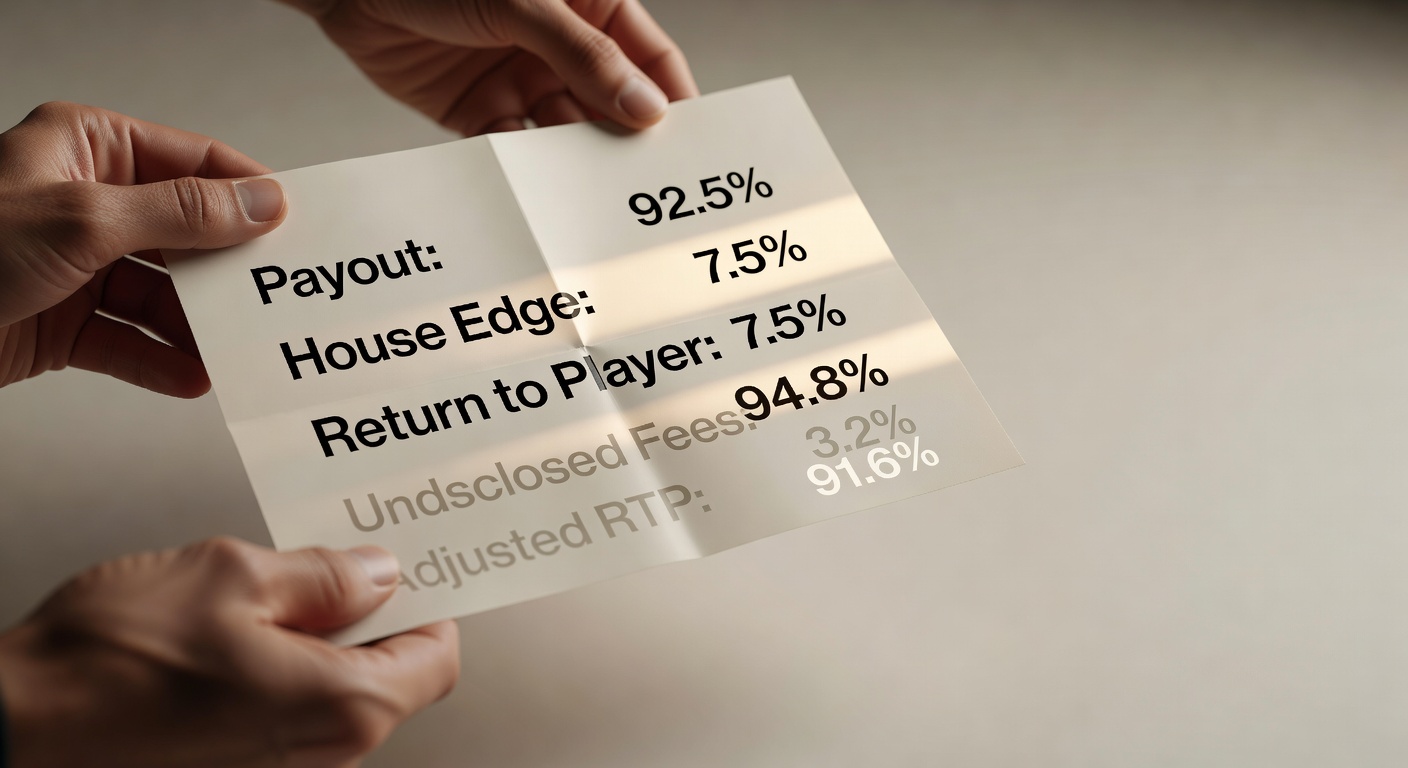
Some casinos publish their monthly or annual payout percentages. They say: for all blackjack hands dealt, we paid out 98.5% of wagers. For all slot machines, we paid out 94%. These numbers are real, audited, and required by law in many jurisdictions. What they mean is not what they sound like.
Payout percentage is calculated as total winnings divided by total wagers. If a casino took 1 million in bets and paid out 985,000 in winnings, the payout percentage is 98.5%. This means the house kept 15,000, or 1.5%. In blackjack terms, the house edge is 1.5% for that period. Sounds close. The player base nearly broke even.
But this number hides everything. First, payout percentage varies by game selection. A casino might publish that slots had 94% payout, which is good. But maybe high-denomination slots (quarter, dollar) had 96% payout while penny slots had 88%. The aggregate number masks the breakdown. A casino publishing the aggregate number in a way that hides the penny-slot data is using accuracy to conceal reality.
The Time Window Problem
Payout percentages are meaningful only over very large sample sizes. Over one month, statistical variance is enormous. A casino might have 96% payout one month and 92% the next month, pure randomness. A card counter sitting at one blackjack table for six hours will see a payoff percentage completely divorced from the long-term expected value.
Publishing monthly numbers creates false precision. It looks scientific. It looks auditable. But it is a monthly snapshot of a system designed to show consistent results only over years. A casino that publishes monthly payout percentages is not lying. They are just using the correct metric in a way that generates false confidence.
This is why Nevada casinos publish annual reports. Annual payout percentages are closer to true expected value. They still contain variance, but less. A casino publishing annual data is more honest than one publishing monthly data, simply because the sample size is larger.
The Difference Between Required and Voluntary
Most jurisdictions require casinos to publish payout percentages. The UK Gambling Commission requires it. Malta Gaming Authority requires it. Nevada requires it. A casino that publishes is following regulation, not offering transparency as a selling point. The publication is mandatory, not optional.
Casinos that actively promote their payout percentages are playing a marketing game. They want you to think about payout percentage as a quality metric. It is not. It is a statement of how much money left the casino as winnings versus how much the casino retained. A 96% payout rate tells you nothing about house edge, nothing about volatility, nothing about whether the casino is treating you fairly.
A fair way to compare casinos would be to publish theoretical house edge by game, which is deterministic. Blackjack with basic strategy has a house edge of 0.5%. Baccarat has 1.06%. These are knowable, fixed numbers. Instead, casinos publish realized payout percentages, which fluctuate with luck. This is exactly backwards.
Why Publish at All
Casinos publish payout percentages because regulation requires it and because the requirement creates the appearance of fairness. A casino that voluntarily discloses its payouts looks more trustworthy than one that keeps the data secret. But the disclosure is compelled, not voluntary. The appearance of transparency is itself a form of marketing.
A player looking at payout percentages as a reason to choose one casino over another is making an error. Payout percentage is mostly luck. You should choose a casino based on house edge (lower is better) and game selection (does it have games you want to play). Payout percentage tells you nothing about either.
So when you see a casino promoting its 95% payout percentage on slots, understand what you are looking at: a number generated by mathematics and luck over a specific time period, required to be published by law, now being marketed as evidence of fairness. The number is accurate but misleading. The publication is transparent but not informative. The casino is following rules while appearing generous.