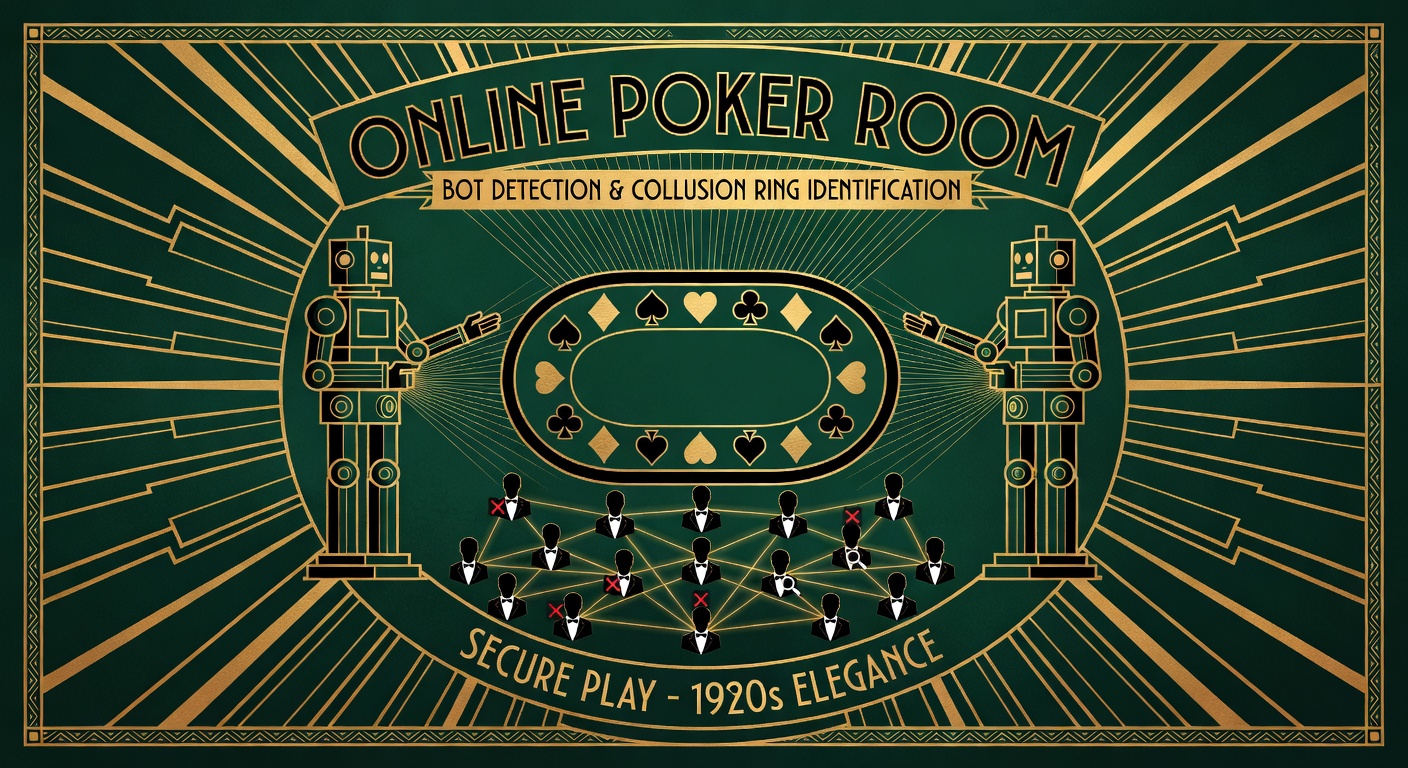
Bot play in online poker has one signature: consistency without adaptation. A human player adjusts to the table. They notice that you are tight, so they attack your blinds more. They see that you are loose, so they tighten their range against you. Humans change.
Bots follow a script. The script was written by a programmer who encoded a strategy. The strategy is then executed without variation. If you exploit the strategy, the bot cannot adjust. It is trapped in its code.
Detecting bots is detecting lack of adaptation.
The Patterns
Bots have tells. Not physical tells; they are on the internet. Behavioral tells.
Consistent bet sizing: A bot will bet the same size in the same situations. A human varies bet size based on psychology, pot control, and hand strength. A bot bets 2.5x the big blind from early position with every premium hand and 0.5x from the button with every weak hand. This consistency is the tell.
No delay in play: A bot plays instantly. A human thinks. Even a quick-thinking human takes a second to make a decision. A bot makes decisions in milliseconds. If you see a player acting instantly every time, across thousands of hands, that is a data point.
No tilt: Humans tilt. They lose a hand they should have won and they play badly on the next hand. A bot does not tilt. It plays identically whether it is up 50 buy-ins or down 50 buy-ins. Over months of play, if a player shows zero variance in emotional response, they might not be human.
No chatter or stats review: Real players review their hand histories. Real players comment on the game. Bots simply play. If a player never discusses the game, never asks questions, never seems to care about anything except playing the next hand, that is suspicious.
The Collusion Detection
Collusion is harder to detect from the outside because the collusion partners want to look like normal players while secretly coordinating.
The signatures:
Improbable fold sequences: Two players are in a hand together. There is a third player who might have both of them beat. One of the collusion partners bets. The other folds instantly. The fold is mathematically reasonable but the speed is suspicious. They are not thinking, they are signaling.
Uneven profit distribution: Collusion pairs take turns winning. Player A wins for a week, then Player B wins for a week, then back to A. Real players would vary based on table conditions and luck. Coordinated players can ensure that one player is profitable while the other loses. It looks normal from outside (both are gaming, both are getting hands), but the outcomes are coordinated.
Consistent head-to-head advantage: If you have two players playing thousands of hands against each other and one player has a statistically impossible win rate (say, 75% of the money in heads-up play), collusion is likely. Real players at similar skill levels should have win rates closer to 50-50.
What You Can Do
If you suspect bots or collusion at your online poker site:
Report it to the poker room. They have security teams. They have tools that track statistical anomalies. If you provide detailed hand history evidence (specific hands with specific concerns), they will investigate.
Change tables. If a table has bots or collusion, it is designed to extract money from you. Leave. There are other tables with normal players.
Play at a regulated site. The UKGC, Malta, and other regulated jurisdictions have stronger security and more resources to detect and prevent bots and collusion. Unregulated sites (Curaçao, Anjouan) have less oversight.
The Reality
Bots and collusion exist in online poker. The level of prevalence varies by site and by stake level. Lower-limit games have more bot activity because the ROI on deploying a bot is higher (cost of bot is fixed, so it needs to extract money quickly). High-stakes games have less bot activity but more sophisticated collusion rings.
Your defense is awareness. Understand the patterns. Report what you see. Play only at sites with strong security. And accept that online poker has a trust tax: you are paying for the convenience of playing online by taking on the risk that not all your opponents are human.