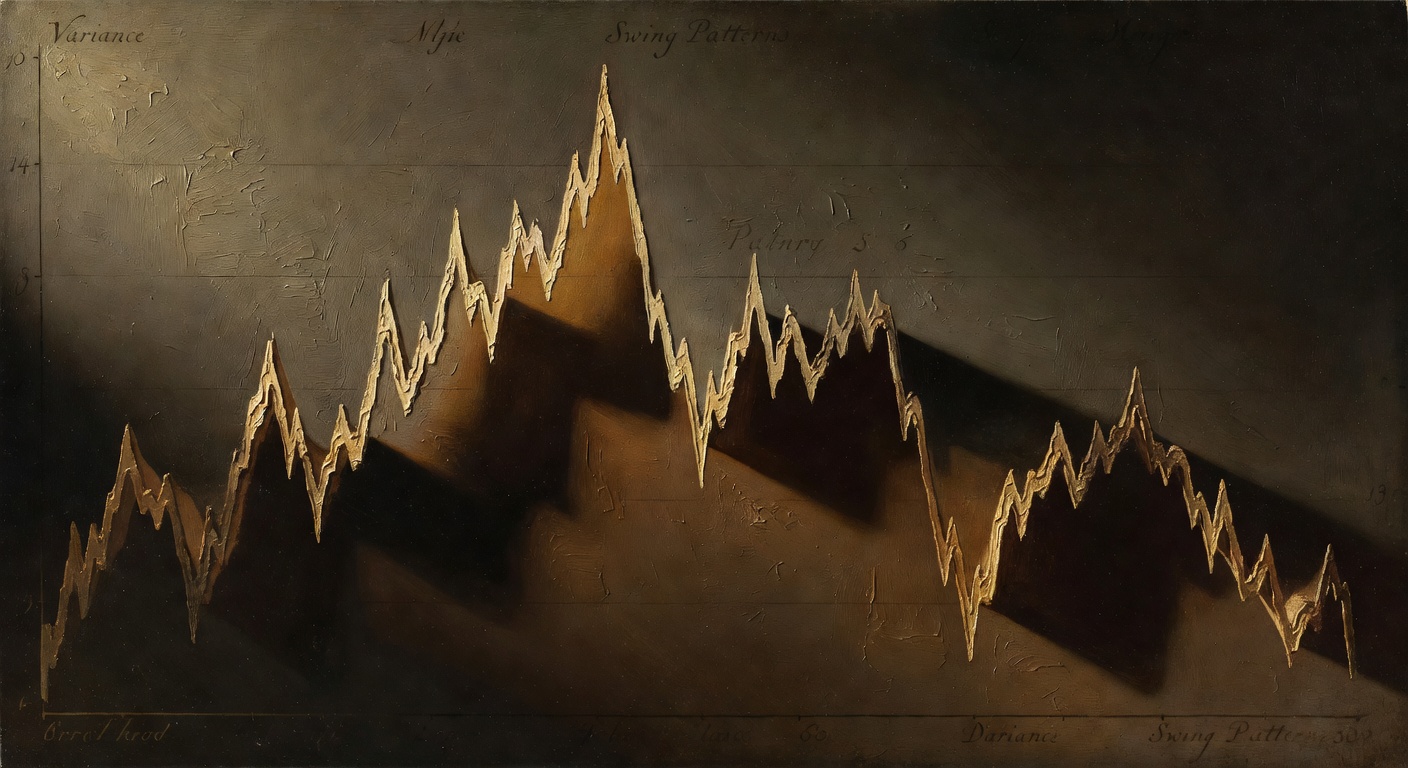
You are up $400 after three days, then down $2,400 by day seven, then up again. Welcome to variance, the reason most poker players eventually walk away broke despite knowing the math favors them. Variance is real, mathematical, completely indifferent to your skill level, and it will wreck your head if you are not prepared.
Variance is the enemy of every player who has ever convinced themselves they are better than everyone else at the table. And sometimes you are. And sometimes that does not matter one bit. You can have a 55-45 edge on every hand and still lose 10 in a row. The probability is low, but over 10,000 hands, you will hit some brutal downswings. The question is whether your bankroll can survive them.
Why Swings Happen
Poker is a game of incomplete information and random cards. You have a 70-30 edge. You win 70 times out of 100 in that spot. You still lose 30 of them. Each time you lose despite having the better hand, it hurts a little more. Humans are loss-averse creatures, remember. Losing $300 that you thought was yours is emotionally equal to winning less than $300. This is where the breakdown happens.
A downswing is not a sign that you suck. A downswing is not the universe punishing you for hubris. A downswing is math asserting itself through a series of cards you do not control. If you have been winning consistently and suddenly you are not, three things could be true. One, your game has declined. Two, your opponents got better. Three, variance ate you. Most of the time it is variance. Most of the time you stay quiet and wait.
The classic indicator of a downswing is when good hands get cracked. You have pocket aces, you get all the money in, someone runs down a straight on you. This happens constantly in poker. The mathematical probability is one thing. The emotional experience is another. Every downswing creates doubt: maybe I am not as good as I thought. Maybe I should have folded that. Maybe the game is rigged.
The Math Inside the Chaos
Here is what the math actually says. Suppose you are a winning player with a 3% win rate per hand. That means over 100 hands you expect to win 3 big blinds more than you lose. Over 1,000 hands, you expect to gain 30 big blinds. But the variance on that 1,000 hand sample is enormous. You could be up 200 big blinds or down 100. Both are entirely consistent with a 3% edge. Over 100,000 hands, variance narrows. Over a million hands, your actual results converge on the theoretical average.
But nobody plays a million hands of poker and then stops. Everybody plays in batches. A session is 6 hours. A week is 40 hours of play. A month is 160 hours. At that sample size, variance is the dominant force in your results. The best players in the world will have months where they lose money. The reason they stay sane is that they accept this mathematically rather than emotionally.
There is a tool called bankroll calculation. You need roughly 300 big blinds of variance cushion to play a game without the risk of total ruin. At $5-$10 blinds, that is $3,000. If you are playing without that cushion, a downswing does not become a learning experience. It becomes a financial emergency.
The Psychological Version
Variance does things to your brain that math cannot predict. You start playing tighter because you are scared of losing. You start playing worse because you are angry about recent losses. You tilt, meaning you play irrationally from emotional pain. Every bad beat stacks on top of the last one until you are playing a fundamentally different game than you were at the start of the downswing.
This is why the best players have strict session limits. They quit when they have lost a certain amount or won a certain amount, whichever comes first. They separate one session from the next. They do not let a downswing on Monday infect Tuesday's game.
Variance is not your enemy. It is just the price of admission to a game where incomplete information means randomness. Accept it, bankroll for it, and you will be in the small percentage of players who come out ahead.