
How to Win Heads-Up Sit-and-Go Matches
A meditation on 24-hand poker as hope encountering mathematics, and why discipline matters more than skill.
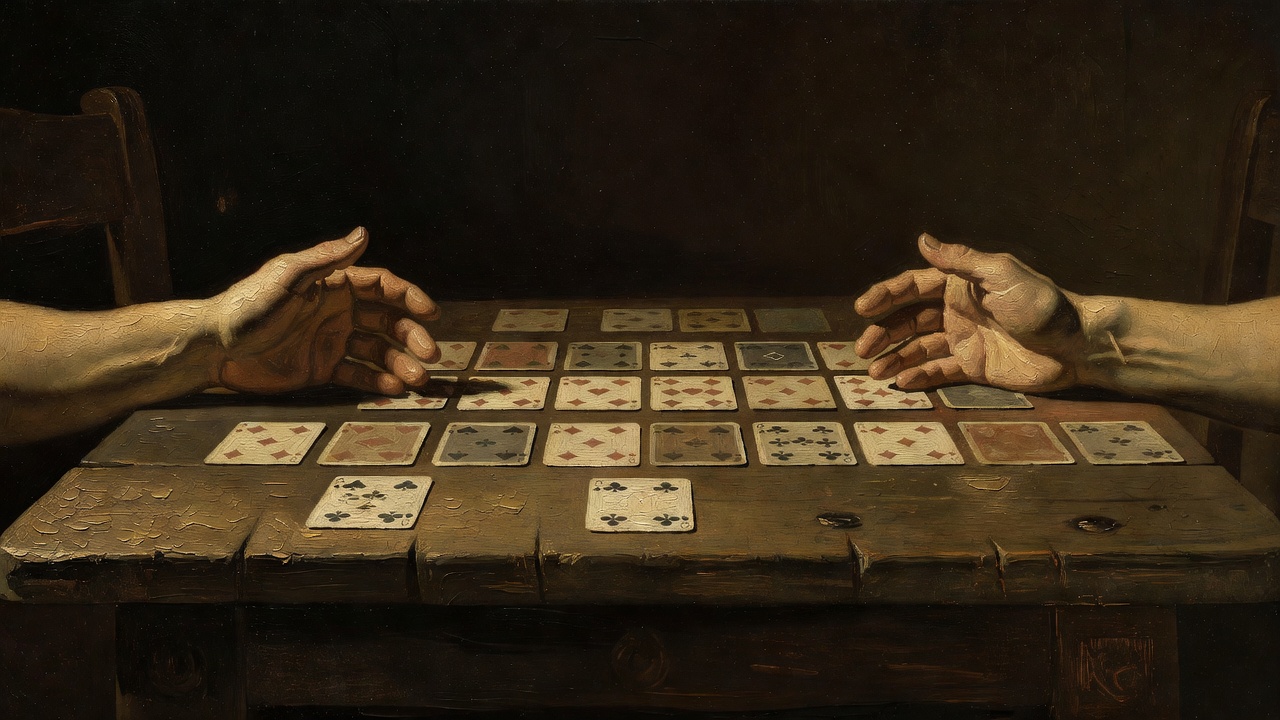
You buy in for $50. Your opponent buys in for $50. Blinds are $1 and $2. You have 24 hands to prove something to yourself.
Heads-up poker requires absolute mathematical understanding and absolute faith that 24 hands will reflect what you know to be true. Most players have neither.
The mathematics are clean. Optimal strategy says open (raise pre-flop) from the button 70 percent of the time. The opponent in the small blind should defend roughly 40 percent. This creates game-theoretic equilibrium. Over infinite hands, neither player can profitably exploit the other. Over 24 hands, variance creates openings. Those openings are what the gambler in you is playing for.
The First Eight Hands
Most losing players tighten their opening range from the button. They think "I will only open strong hands." This is suicide. If you open only AA, KK, QQ, AK, AQ, your opponent faces a small range and can fold almost everything. You give away the mathematics to avoid discomfort.
Open 70 percent of your hands. This means opening 43 suited and 3s. You feel like you are donking chips away. You are not. You are building a distribution that makes your opponent's job unsolvable.
Over the first eight hands you should win three or four pots uncontested. You should see two or three flops where the outcome is unclear. You should lose one showdown. If you are down 15 big blinds ($30 of your $50) after eight hands, you are running below expectation but survivable.
Hands 9 Through 16: Flop Play
This is where discipline dissolves. Your opponent has now seen your patterns. They may have started defending properly or trying to trap you.
The mistake is adjusting to what you think you have seen rather than to the mathematics. You cannot accurately judge your opponent's strategy from eight hands. You can only judge your own discipline.
If you think you have "read" your opponent as loose after eight hands, you are probably wrong, and you are probably about to make a bigger mistake. Strong players do not change strategy in response to noise. They continue opening 70 percent. They continue defending the blind at 40 percent. They continue playing flops with geometric precision.
This is excruciating. This is also correct.
Hands 17 Through 24: Endgame
With eight hands remaining, chip stacks will be uneven. One player has $70, the other $30. The short stack is in push-fold: all-in or folding, almost every hand.
Weak players think: "I have to tighten and wait for a premium hand." The mathematics say the opposite. If short-stacked, push almost every hand. This is correct because you are mathematically indifferent to the outcome. You are at the mercy of variance anyway.
The chip leader can afford to fold to aggression until the final hand. The final hand in a 50-50 situation is a coin flip. One player experiences an outcome that feels conclusive. They are experiencing variance over 24 hands.
Heads-up sit-and-go teaches you the difference between correct play and correct outcomes. You can play perfectly and lose. You can play poorly and win. You control the process. The outcome is noise. That is what you are buying. The chance to believe in the process for 24 hands.

Filed on
Shelved alongside
- BN·S646
Spin the Wheel Bonuses: A Look at Gamified Promotions
Gamified promotional mechanics are structured betting offers that require specific regulatory treatment. This analysis examines their classification and compliance requirements across jurisdictions.
By Play Trump Casino Reading Room
- GD·C278
Casino War: The Simplest Table Game Explained
Casino War is a game where you compare one card to the dealer's one card. That's the entire game. Here's how it works and why people play it.
By Play Trump Casino Reading Room
- GD·T374
How to Test a New Table Game Without Risking Too Much
The impulse to try a new game activates reward circuits before the first card is dealt. This is not superstition.
By Play Trump Casino Reading Room
- BC·S723
Stanley Ho's 40-Year Macau Gambling Monopoly Explained
Stanley Ho Hung Sun lived most of his life in a territory where he was, for practical purposes, the government.
By Play Trump Casino Reading Room