The ball comes to rest in the zero pocket. The roulette wheel stops. Every player with an even-money bet (red, black, odd, even) looks at their chips.
In most casinos, those chips are gone. Zero wipes everything.
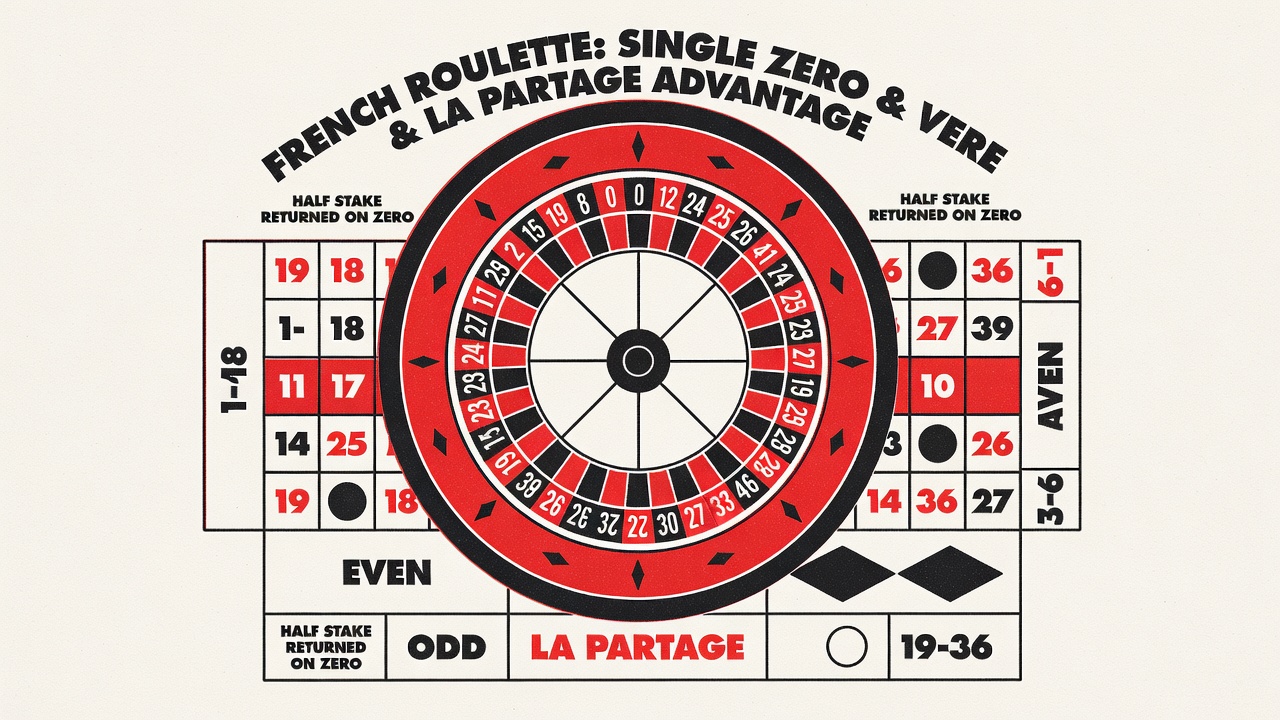
In casinos that offer la partage, half the chips return. The house takes the other half. It's a compromise between total loss and breaking even.
This might seem like a small thing. It wasn't. It fundamentally changed which cities could attract serious gambling players.
The Setup
European roulette has 37 numbers: 1 through 36 plus zero. When you bet red or black, you're essentially choosing 18 numbers out of 37.
Your probability of winning is 18/37. Your probability of losing or getting zero is 19/37. The house's advantage is that one extra outcome.
That translates to a 2.70% house edge without la partage.
The La Partage Rule
With la partage, zero hits, and your bet splits. You lose half, you get half back. Mathematically, this changes your losing scenarios.
Now zero isn't a complete loss. It's a half-loss. Your expected value improves. The house edge drops to 1.35%.
Why This Matters Economically
For a wealthy person considering whether to gamble, a 1.35% edge feels different from a 2.70% edge. It feels half as predatory.
Over a thousand bets, a 2.70% edge means losing $2,700 on $100,000 wagered. A 1.35% edge means losing $1,350.
For high-stakes players, the difference between those two scenarios determines which city they visit.
The Competitive Angle
Monte Carlo offered la partage to compete with other European casinos. Not all of them had it, but the ones that did attracted better clientele.
Casinos in America never felt this pressure. The US market was too large and fragmented. A single casino could offer worse terms and still fill tables.
Europe's smaller geography meant direct competition. Competition meant better terms for players.
The Psychological Component
Beyond the math, la partage feels fairer. Players understand intuitively that losing half is better than losing everything.
Casinos understand this too. They market it: "Better odds. Fairer game."
The fairness perception increases repeat play. A player who thinks they were treated fairly at roulette comes back. A player who thinks they were cheated doesn't.
The Modern Evolution
En prison is la partage's cousin. Instead of losing half, your bet is locked for one more spin. If you win, you get it back. If you lose, it's gone.
Mathematically equivalent. Psychologically different. Players feel like they get another chance.
The Geographic Split
La partage and en prison are standard in European and some Asian casinos. They're rare in Las Vegas and Atlantic City.
American casinos operate with single-zero roulette but no la partage. European casinos often have la partage or en prison.
This creates a quality gap: European roulette is demonstrably fairer to the player than American roulette.
Why Players Don't Notice
Most casual roulette players don't know la partage exists. They don't calculate house edge. They sit down, bet, spin, and leave.
The players who do know prefer casinos with la partage, but they're a minority. The casinos that offer it are signaling to a specific audience: "We're confident enough to reduce our edge."
The Legacy
La partage started in 1865. Over 150 years later, it's still a distinguishing feature of some casinos and not others.
Small rule changes compound. A rule that seems minor at first becomes a mark of quality over decades.