I spent two years sitting in a back corner of a Atlantic City casino, just watching. Not playing. Just watching the slot players. The rhythms they had. The rituals. The ones who came back every Tuesday and Thursday. The ones who showed up at 8am when the machines had just been serviced.
One woman in particular, Margaret, had been coming to the Borgata for 18 years. She played the same machine bank. She'd arrive at 9:15am. She'd play until 11:30. Then she'd return at 3pm and play until 5:30. Same rhythm. Same machine.
But what interested me most was the notebook.
The Record System
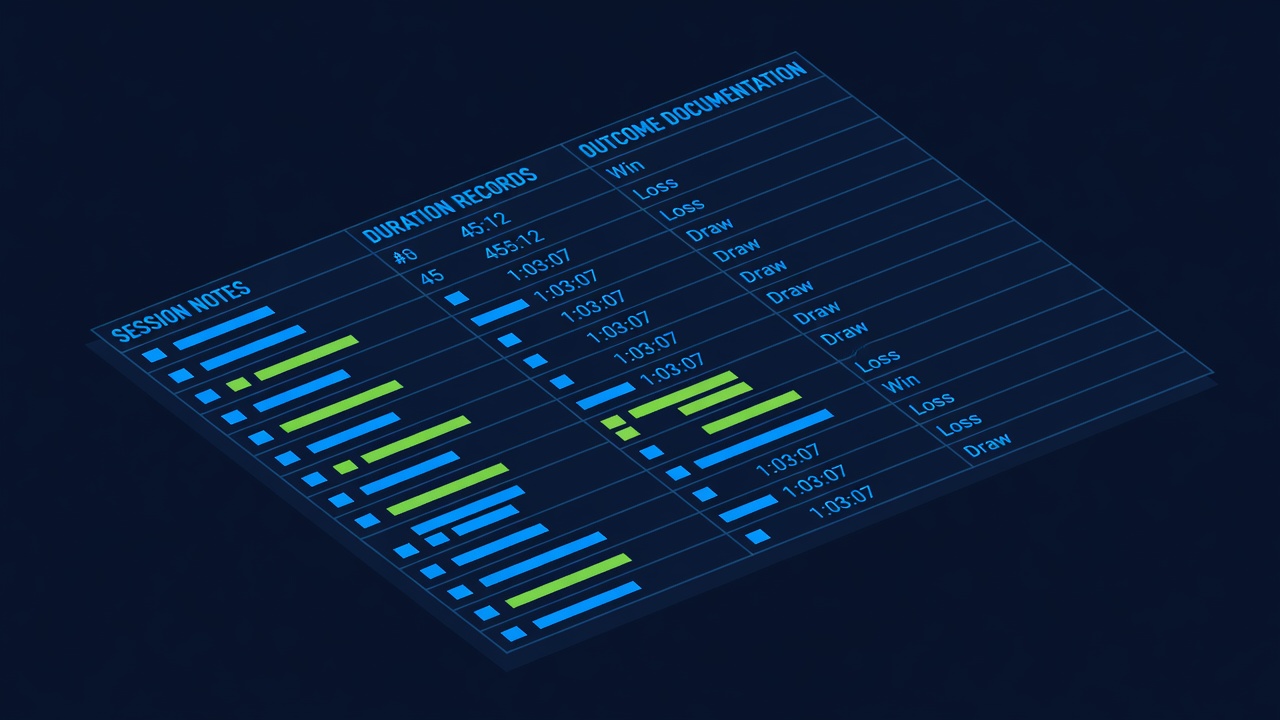
Margaret kept a composition notebook. She recorded every session. The date, the machine number, the starting meter, the ending meter, the dollar amount spent, any bonuses that hit, the time she played. At the end of each week, she'd total it up.
I eventually asked her about it. She showed me her records. Going back years. The handwriting was precise. The columns were neat. She could tell you, without hesitation, what her average loss per hour was on Machine 5-B12, what her biggest win was, which month her returns were worst.
When I asked why she kept such detailed records, she said: "Because I want to know what I'm actually buying."
That phrase stayed with me. She wasn't treating slots as gambling. She was treating it as a purchase. The notebook was her receipt.
What Real Players Track
The serious slot players I met were not sophisticated mathematicians. Most barely finished high school. But they had an implicit understanding of variance and sample size.
They tracked the machine name, the payback percentage if they knew it (usually they had to estimate), the session date and time, how long they played (to the minute), how much they brought in, how much they left with, and any bonus rounds that triggered.
Some players also tracked the specific bonus features. One man I met, retired from construction, kept separate columns for free spins bonuses versus scatter bonuses versus pick-a-box style bonuses. He'd been doing this for 8 years. He could tell you which bonus feature had the highest expected return based on his sample data.
Was his sample data actually predictive? No. Slots are RNG-driven; past performance tells you nothing. But the act of tracking made him feel like he was exerting control. And more importantly, it gave him data he could study when he wasn't playing.
The Psychology
Tracking is partially about harm reduction. When you sit down with a $300 budget and maintain a detailed record of every hand you play, you're creating friction between impulse and action. You can't pretend you lost $40. The notebook says you lost $127. The specificity matters.
Margaret told me that keeping the notebook had reduced her spending over time. Not because she realized she was losing (she knew that). But because the routine of recording it made the loss concrete. She couldn't ignore it the way she could ignore a vague sense of "I spent more than I planned."
This is the surveillance theory of self-control: if you're watching yourself, you change behavior. Margaret was her own surveillance system.
The Data She Kept
Margaret's notebook had columns for:
Date / Machine ID / Time In / Time Out / Starting Bankroll / Ending Bankroll / Amount Spent / Bonus Trigger / Bonus Type / Bonus Payout / Notes
The notes were where it got interesting. "Machine 5-B12 seemed looser today," she'd write. Or "Sat next to drunk guy, was distracting." Or "Came in hungry, left after 45 minutes instead of normal 2.5 hours."
She understood that her own state affected her results. She wasn't tracking the machines. She was tracking herself playing the machines.
When I asked her if she thought the notebooks made her a better player, she laughed. "There's no better or worse at slots. You can't improve. You can just understand what it's costing you."
Why Casinos Don't Encourage This
Casinos notice when players keep detailed records. It's not against any rule. But floor staff will sometimes ask what a player is writing down. They'll sometimes ask to see the notebook. Not to stop the player, but to understand what's being tracked.
If a casino discovers that a serious player is tracking machine volatility across weeks or months, they might move that machine or reshuffle the location of the good machines. They'll never admit that's why. They'll say they're just updating the floor layout.
But they know that a player with detailed data across 300+ sessions has better information than they do. Most casinos want players who feel like they're playing against randomness. They don't want players who've actually internalized the randomness through sustained record-keeping.
What The Numbers Actually Say
Margaret had 8 years of data by the time I met her. Over that period, she'd documented 2,847 sessions. Her average session length was 2 hours and 14 minutes. Her average spend per session was $94. Her win rate was 23% of sessions (she left with more money than she came in with).
Her biggest win was $440 on a free spins bonus. Her biggest loss was $280 in a session where she chased a bonus that never came.
Her return-to-player, calculated from her own data, was 84.3% across her sample. Actual RTP for modern slots is 85-95% depending on the machine, so her data roughly tracked reality.
But she couldn't improve her returns. Better record-keeping doesn't change odds. It just documents them.
Why This Matters
The ethnographic reality of serious slot players is that they're not trying to beat the game. They're trying to understand it. The notebook is their way of making an invisible process visible.
This is the unspoken culture of the slots: the players who last aren't the ones who get lucky. They're the ones who watch closely enough to see what luck looks like over time, and who accept it.