The Economics of the Fee
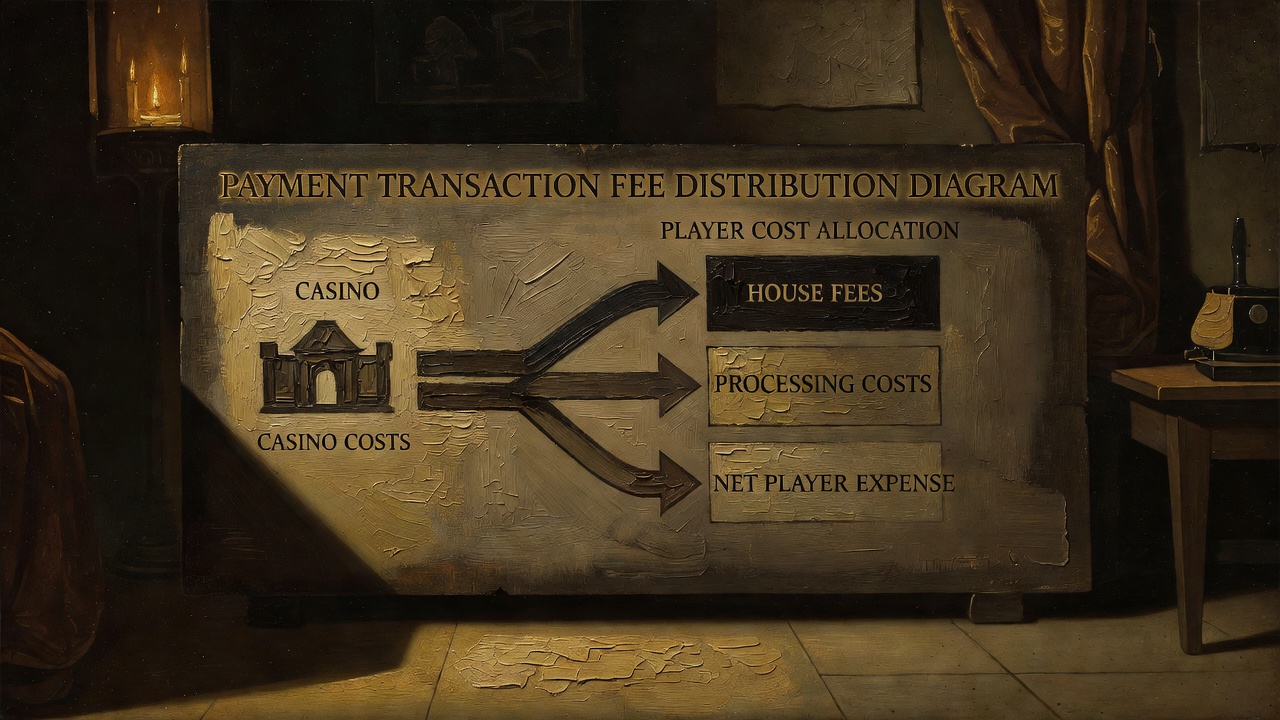
When you deposit $100 at a casino using a credit card, a payment processor handles the transaction. The processor charges the casino a fee. Usually 2.9% plus $0.30. That's $3.20 on your $100 deposit.
The question is: who eats that fee? The casino or you?
The answer is: it depends, and that's the whole conversation.
Casinos That Eat the Fee
Most major licensed casinos absorb payment processing fees on deposits. They treat it as the cost of acquiring a customer. You deposit $100, they pay the 2.9% fee, and you have $100 to play with.
Why do they do this? Because if they passed the fee to you, you'd feel ripped off. You'd see a "payment fee: $2.90" and you'd feel cheated before you've even started playing. The friction that creates isn't worth the $2.90.
Instead, they eat the fee and let you play. They figure that over your lifetime as a customer, they'll make it back.
Casinos That Pass the Fee
Smaller or less scrupulous casinos sometimes pass processing fees to players. You request a $100 deposit. You're charged $102.90. Your account shows $100 but you paid $102.90.
This is permitted under most payment terms, but it's a red flag. If a casino is unwilling to absorb a 2.9% cost of customer acquisition, they're probably operating at thin margins. Thin-margin casinos sometimes cut corners on licensing, security, or software quality.
Withdrawal Fees Are Different
Withdrawal fees are almost never passed to players. If they were, you'd request $500 and receive $485. The casino would pocket the difference.
Instead, casinos typically absorb withdrawal fees just like deposit fees. A $500 withdrawal to a bank account might cost the casino $15-25 in wire fees and processing. They eat it.
Why? Because when you're withdrawing, you're leaving. The last thing they want is for you to feel ripped off on your way out. Better to lose $15 and have you come back later than to nickel-and-dime you on the exit.
Cryptocurrency Changes Everything
With crypto, withdrawal fees are variable and sometimes visible to the player. A Bitcoin withdrawal might cost $1-5 depending on network congestion. An Ethereum withdrawal might cost $5-30.
Some casinos include this in their payout. You request $500 in Bitcoin, they send $495 in Bitcoin, and the $5 is the mining fee. Other casinos send the full $500 and eat the fee themselves.
Crypto is newer, so less standardized. You have to check the casino's terms.
VIP Programs and Fee Waiving
High-volume players sometimes get fee waivers written into their agreements. A whale depositing $50,000 per month might negotiate "no withdrawal fees ever" as part of their VIP deal.
This is rare for regular players, but it's worth asking about if you're depositing large amounts regularly.
The Fee Structure Reveals Risk
A casino that willingly absorbs all fees and never passes costs to players is signaling that they expect to make money from your play. That's confidence. That's a casino that thinks they can recoup the fees through house edge.
A casino that passes fees to players is signaling that they're uncertain about customer lifetime value. They want to capture the fee upfront because they're not confident you'll play long enough to cover it.
This is a subtle but real signal about which operators are financially healthy.
The Math for the Player
Fees matter most on small deposits. A 2.9% fee on a $100 deposit is $2.90. On a $5,000 deposit, it's $145. If the casino eats it, that's still money they're not taking from you.
If you're playing at a casino with a 1.5% house edge and you want to play for 100 hours, your expected loss is $1,500 on a $10,000 bankroll. Whether the casino eats a $290 fee or charges it to you is significant. It changes your expected loss by roughly 2%.
Online Only Casinos vs. Licensed Operators
Licensed operators (UK, Malta, Curacao with real oversight) almost universally absorb fees on both deposits and withdrawals. It's part of the cost of doing business.
Unlicensed operators and questionable offshore casinos are more likely to charge fees. They're also more likely to have other sketchy fee structures: withdrawal minimums, daily withdrawal limits, "processing fees" that aren't actual processing costs.
The fee structure is one of many indicators of whether an operator is professional.