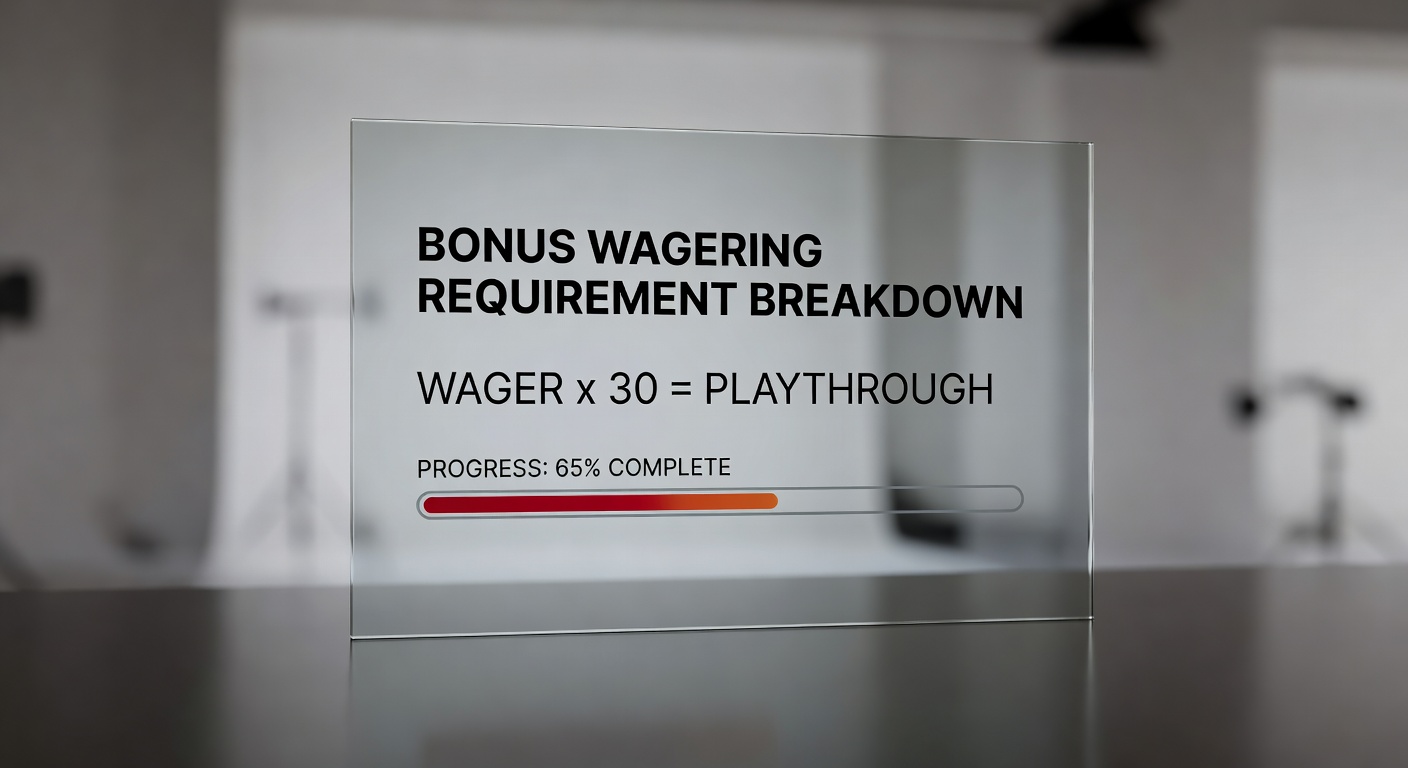
A hundred-dollar bonus with a 35x wagering requirement is not a hundred dollars. It is a call option on a hundred dollars, exercisable only after you push three thousand five hundred dollars of volume through a game with a house edge. The moment you accept the bonus, you have written a short position in your own free time, and the casino has taken the other side of it.
Richard Thaler would recognize the problem immediately. So would Daniel Kahneman. The bonus is an exercise in mental accounting at its most pure: the operator frames the money as a gift, the player accepts the frame, and the frame does more cognitive work than any promotional copy ever could.
The Wagering Requirement as a Contract
When you opt in to a bonus, you sign, implicitly, a contract with a notional value and an expected cost. The notional value is the bonus face amount. The expected cost is the product of three variables: the wagering multiplier, the effective house edge on eligible games, and the restriction on bet sizing and games.
A hundred-dollar bonus with a 35x requirement played on a slot with a 4% house edge has an expected cost to you of 35 times 100 times 4%, or 140 dollars in expected losses over the required turnover. On its face, the bonus is negative expected value.
There is, however, a second term. The wagering can sometimes be completed on games with a lower house edge, if the operator allows it. Blackjack played at half-weighting against a 0.5% house edge produces a different number entirely. The arithmetic rewards the patient reader.
This first section is about framing. The rest is about measurement.
The Odometer Problem
The casino interface shows a progress bar. The progress bar is a design decision. It is also, according to work by Kivetz, Urminsky, and Zheng in 2006 on the endowed-progress effect, a remarkably effective engagement tool. Humans finish what has been started, especially when the finish line is visually represented. Give someone a loyalty card with two stamps already punched and they are measurably more likely to fill it than someone starting from zero, even when the total stamps required are identical.
The progress bar on a bonus works the same way. Every wager moves a sliver of the bar. The brain, trained on progress bars since the first Nokia download screen, registers the sliver as forward motion and suppresses the question of whether the direction is worth the motion.
The first discipline, therefore, is to measure progress in your own numbers rather than the operator's visual. Keep a spreadsheet. Two columns: cumulative wagered, cumulative net result. Update after each session. The casino's progress bar is for the casino. Your spreadsheet is for you.
Loss Aversion in the Home Stretch
Kahneman and Tversky's 1979 paper on prospect theory demonstrated, in a result that has held up across four decades of replication, that humans weight losses roughly twice as heavily as equivalent gains. This is most dangerous in the home stretch of a wagering requirement, when the player has completed most of the turnover and sees the finish line in view.
At 80% completion, a typical player has three psychological levers pulling at once. First, the sunk-cost illusion: they have already invested hours, so stopping feels like waste. Second, loss aversion: their balance has dipped, so continuing feels like the path back to whole. Third, the endowed-progress effect: the bar is almost full, and the brain wants it filled.
The result is often a tilt session that undoes much of the wagering gains. A disciplined player will know this in advance and will build the possibility into their expected value calculation, not as an abstraction but as a specific dollar amount they are prepared to lose without panicking.
What to Track, Specifically
Keep the following in a spreadsheet or a plain notebook.
- Date and session start time.
- Starting balance, including bonus and real money broken out.
- Cumulative wagered toward the bonus requirement.
- Remaining wagering requirement in dollars.
- Net session result, in dollars, positive or negative.
- Game and average bet size.
- Time spent.
The time column matters more than most players think. A bonus that takes eighteen hours of slot sessions to clear has an hourly expected value. Calculate it. You may find that your time is worth more as an hourly wage at something else.
The Question of Weighting
Eligible games are weighted differently toward the requirement. Slots typically count 100%. Roulette often counts 20% or 10%. Blackjack sometimes counts 5%, sometimes zero.
This is not a detail. A bonus cleared on slots at 100% with a 4% house edge has a different expected cost than the same bonus cleared on a 5%-weighted blackjack table with a 0.5% house edge. Run the math before choosing the game. The answer is often counterintuitive, because the lower weighting means you need to wager twenty times more volume, which multiplies against a much lower edge in a way that sometimes favors the player and sometimes does not.
The calculation is available in closed form. I will not insult you with a spreadsheet template.
A Note on Behavioral Hygiene
The cleanest bonus session is one you planned before you opted in. The plan has three parts.
- A stop-loss, denominated in real money rather than bonus dollars, below which you walk away from the bonus entirely, forfeit the remaining wagering, and accept the sunk cost.
- A fixed bet size, calculated to give you enough hands or spins to have a reasonable probability of completing the requirement within your stop-loss.
- A session cap, measured in time, not in outcomes. One hour. Two. Whatever you can sustain with attention intact.
A bonus executed without this scaffolding will be executed by the casino's scaffolding instead, which is optimized for the casino's purposes, not yours.
Closing the Loop
The interesting thing about wagering requirements, from a behavioral economics perspective, is that they are one of the few consumer products where the expected cost is knowable in advance with precision and the product is nonetheless widely purchased at a loss. This is not a failure of the consumer. It is a predictable outcome of well-designed framing interacting with the standard biases of the human decision-making apparatus.
The consumer is not stupid. The consumer is exactly as smart as the consumer has always been. The bonus is merely well designed.
So, too, should be your response to it.