Blaise Pascal was seventeen years old in 1640 when he began studying mathematics and physics in Paris. He was brilliant and impatient. His interests moved fast. One of his projects was designing a perpetual motion wheel.
A perpetual motion wheel is a machine that, once set in motion, continues moving forever without external energy. It's theoretically impossible, but seventeenth-century physicists kept trying.
Pascal's design used a wheel divided into compartments. As the wheel turned, the compartments would shift and redistribute. He thought he could design it so that the distribution kept the wheel spinning perpetually.
It didn't work. Perpetual motion wheels never work. But the wheel he built had an interesting property: it turned unpredictably. You couldn't predict which compartment would come up.
The Accident
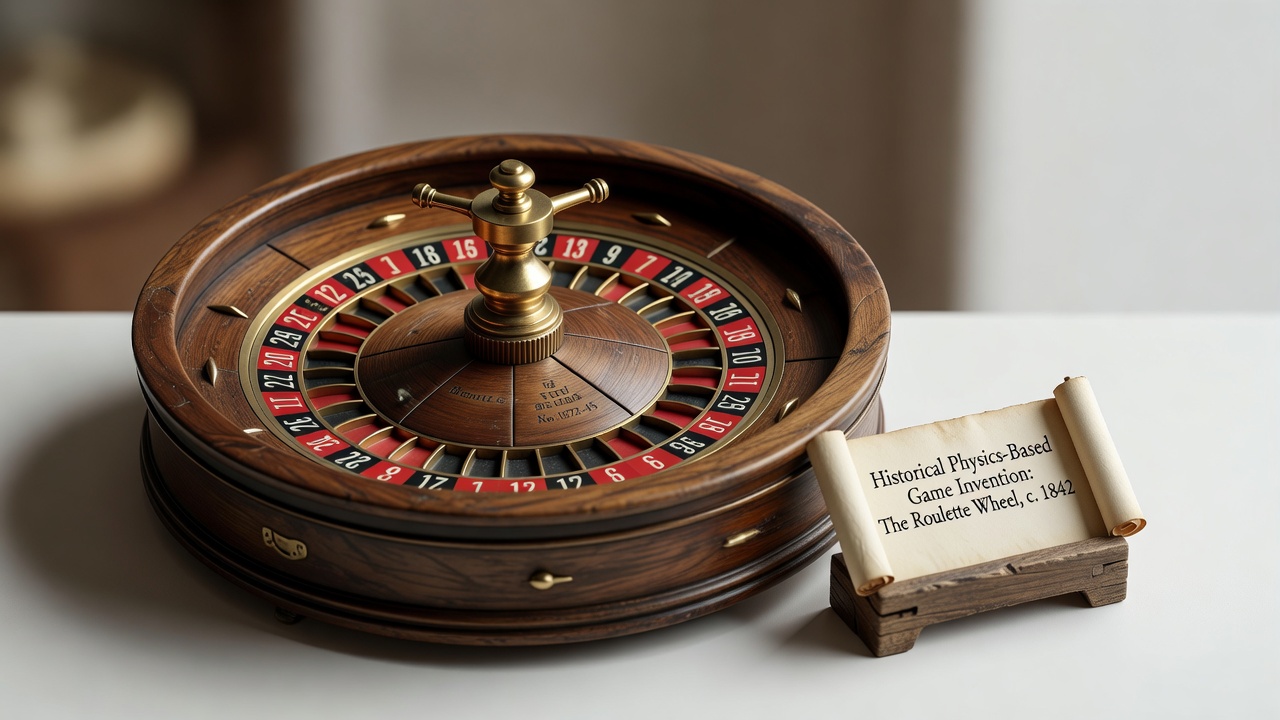
Pascal abandoned the perpetual motion project. But he kept the wheel. He put a betting surface under it. He marked compartments with numbers. He invited friends over and they started betting on which compartment would land in front.
That was 1655, roughly. The wheel had no name yet. It was just an object that produced random results.
Pascal wasn't trying to invent a game. He was trying to prove a mathematical point about probability. He built the wheel to generate random data so he could study the distribution of outcomes.
Friends started betting on the outcomes. For fun at first. Then for money. By 1660, the wheel had become a popular gambling game among French nobility.
The Mathematics
Pascal was studying probability as part of his larger work on the foundations of mathematics. He had a correspondence with a mathematician named Pierre de Fermat about probability theory.
Their discussion led to some of the earliest formal work on probability. Pascal used the spinning wheel to demonstrate principles. Fermat provided theoretical analysis.
Without meaning to, Pascal had created a perfect object for studying probability: a wheel that produces random outcomes in a distribution you can control by changing the number of compartments.
The Spread
French casinos adopted the wheel game quickly. They modified it: added more compartments, formalized the rules, standardized the betting positions. By the early 1700s, roulette (as it came to be called, from the French word for small wheel) was a standard casino game.
Each casino's wheel was slightly different. Some had 36 compartments. Some had 37 (with a 0). Some had other variations. The game wasn't standardized until much later.
The Spread to America
When roulette came to America in the 1800s, casinos modified it. They added a double zero (00) to increase the house advantage. This was the first major rule change from Pascal's original wheel.
American roulette became standard in Nevada and Atlantic City. European casinos kept the single-zero wheel, giving players better odds.
The American decision to add the double zero was pure economics. A 2.70% house edge (single zero) wasn't enough. They wanted 5.26% (double zero). The difference made millions of dollars over decades.
The Philosophical Point
Pascal didn't set out to invent gambling. He set out to invent a machine for studying probability. That a machine designed for mathematics became an instrument for losing money is perhaps fitting.
It suggests something about gambling: it's not fundamentally different from other human activities. It's just probability meeting human psychology. The wheel was originally a teaching tool. It became a device for transferring wealth. The mechanics were always the same.
Why This Matters
When you sit down at a roulette table, you're using a mathematical device that was invented by one of history's greatest mathematicians, accidentally, while trying to build something that would never work.
The irony is dense: a tool created to understand randomness became the means by which randomness reliably extracts money from those who play it.
Pascal understood probability deeply. He understood that roulette was a negative-expectation game. He knew, mathematically, that the house had an edge.
Yet people played anyway. They played for more than three centuries. They still do.
The wheel that was supposed to teach probability ended up teaching something else: that humans will bet against the math if the moment is exciting enough.