Rachel had been playing Ethereum on Stake for six months when I met her at a friend's dinner party. She explained her strategy with the enthusiasm of someone who'd found religion. "You set a pattern," she said. "The crash follows patterns. You study them and you get out before it goes."
She had a spreadsheet. Forty games analyzed. Notes on when to exit based on the previous 10 crashes. She showed me a hand-drawn chart showing which multipliers triggered crashes most frequently.
She'd lost $3,000.
But she wasn't talking about the loss. She was talking about the patterns.
How The Game Works
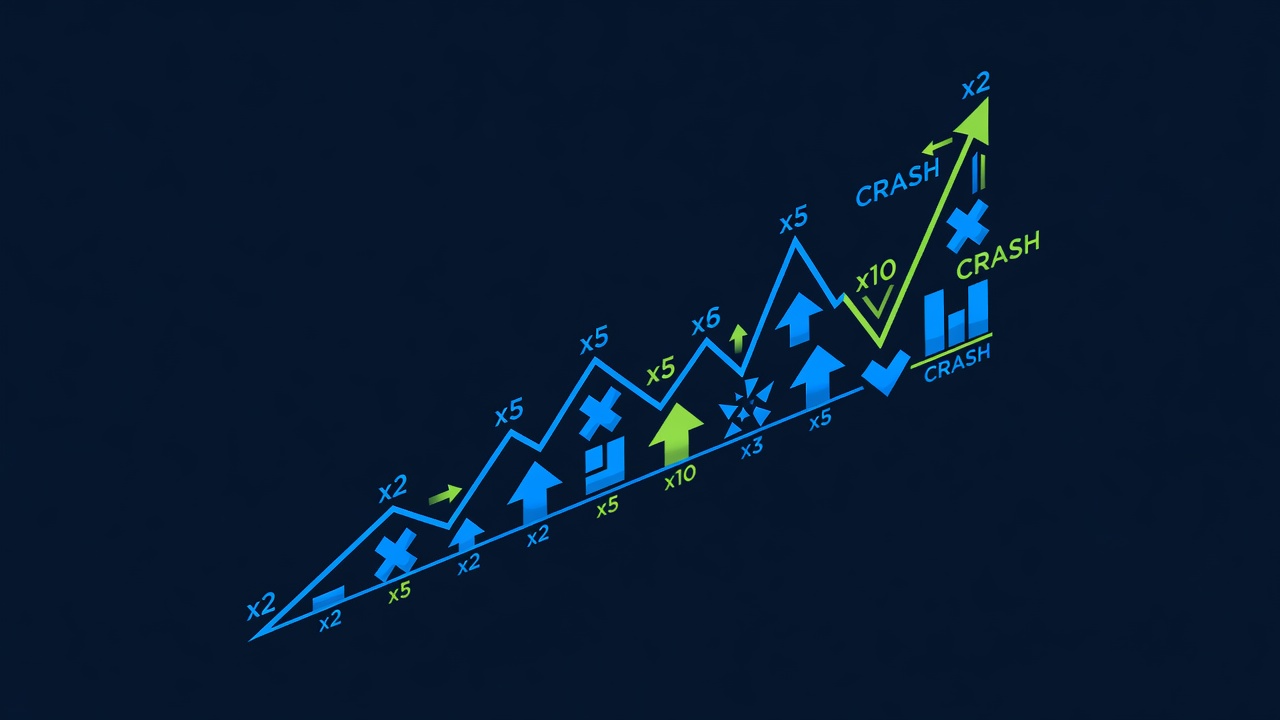
A crash game is simple: a multiplier starts at 1.0 and climbs. 1.2x, 1.8x, 3.5x, 12.1x, 24.6x. You place a bet before the round starts. While the multiplier is climbing, you click "cash out."
When you cash out at, say, 4.5x, you win your bet multiplied by 4.5. So a $100 bet cashed out at 4.5x becomes $450.
But the multiplier keeps climbing. If you don't cash out and the game crashes (which happens without warning), you lose your entire bet.
That's the whole tension: stay in and hope it climbs higher, or cash out early and take the certain win.
The Probability
The crash point is determined by a random number generator (supposedly). Each game has a different crash point. Some crash at 1.1x (you barely make anything). Some crash at 200x (you could make $20,000 on a $100 bet).
The casino publishes the mathematical distribution: 50% of games crash before 2x, 25% crash between 2x and 5x, 15% crash between 5x and 10x, 10% crash between 10x and 100x, and so on.
If the math is honest, the expected value works out like this: 50% of $100 bets return $200 (break even). 25% return $250 to $500 (slight gain). 15% return $500 to $1000 (big gain). 10% crash at some high multiplier.
If you always cash out at a fixed multiplier, say 2.0x, you'd win 50% of your bets at 2x return and lose 50% at total loss. Your expected value is negative. You lose money over time.
Why People Believe They Can Win
Rachel's spreadsheet represented the gambler's fallacy at its purest form. She thought crashes followed patterns. They don't.
A crash game might have ten consecutive crashes below 2.0x, then five consecutive crashes above 10x, then back to low crashes. To the eye, it's a pattern. To the RNG, it's randomness that occasionally looks patterned.
The human brain is built to find patterns, even in randomness. We see the pattern so clearly that we think we can exploit it.
The Skill Illusion
Crash games feel like skill games because you have to make a decision: when to cash out. That decision point creates an illusion of control.
You're not controlling anything. The multiplier's path is determined before the round starts. You're just guessing where the crash point is. When you guess correctly, you feel smart. When you guess wrong, you tell yourself you'll guess better next time.
Rachel told me she'd gotten a 20x on a single bet: a $100 bet turned into $2,000. "That's when I knew I could do this," she said. She'd won big once, which felt like proof of concept. Over the next five months, she lost it all trying to replicate it.
The House Edge
Crash games publish their house edge, usually 1-2%. That means over a large sample, the casino keeps 1-2% of all money wagered. You lose money statistically, over time.
But "over time" is the key phrase. In the short term, variance dominates. Rachel won $2,000 in one night and lost confidence in the RNG. She thought she'd hacked it. She spent the next weeks trying to recover that feeling by understanding the pattern.
The pattern was luck.
Why Casinos Love Them
Crash games have two properties casinos love: fast rounds (new game every 20-30 seconds) and high engagement (you're making constant decisions).
Slots are passive. You spin and wait. Crash games are active. You're watching the multiplier climb and deciding. That engagement increases play volume.
Faster rounds mean faster money cycling. A crash game player might place 50 bets in an hour. A slot player might place 30. Over thousands of players, the volume difference is substantial.
The Math That Doesn't Save You
Some players try to exploit the published distribution. "If low crashes (below 2x) happen 50% of the time, maybe I should always cash out at 1.9x." This guarantees you lose less frequently.
But the payout is 1.9x, which means you're breaking even (in expectation) minus the house edge. You're playing a negative-expectation game optimally. You still lose money.
There's no strategy that turns a negative-expectation game into a winning game, assuming the RNG is honest.
The Recovery Trap
Rachel lost $3,000 and decided to deposit another $1,000 to try to "win it back." She lost that $1,000 too.
Then she quit.
She was lucky. Many people don't quit. They keep thinking the pattern exists. They keep playing to recover. They lose their bankroll.
The crash game is designed to feel like you understand it. You watch the multiplier rise. You feel like you're reading something. You're not reading anything. You're watching a random number being revealed in slow-motion.
The slower it reveals, the more engaged you get, and the more times you'll misguess.