The Setup
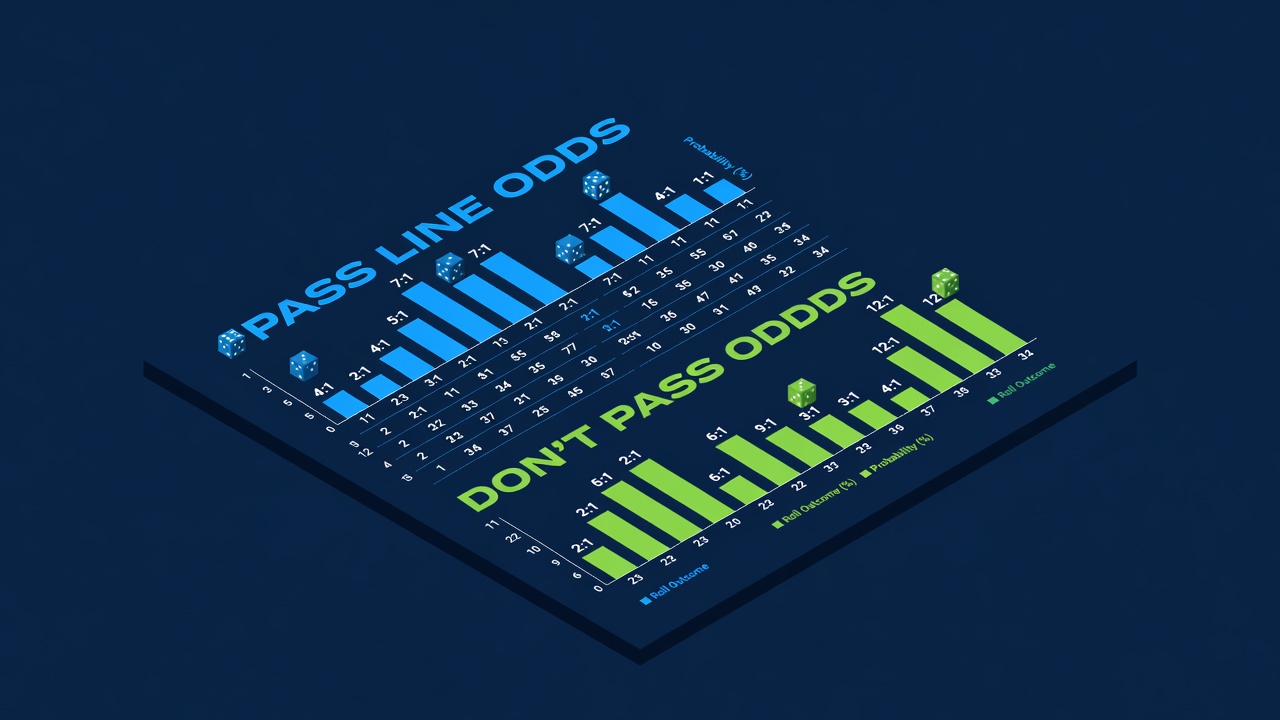
Pass Line: you win on a 7 or 11 on the comeout roll. You lose on 2, 3, or 12. Everything else establishes a point, and you win if the point hits before a 7.
Don't Pass: opposite. You lose on 7 or 11. You win on 2 or 3. You push (no decision) on 12. If a point is established, you win if a 7 hits before the point.
They look symmetrical. They're not.
Claim: They Have the Same Edge
Wrong. Pass Line carries a house edge of 1.4%. Don't Pass carries a house edge of 1.36%. The difference is 0.04 percentage points, which sounds microscopic until you multiply it across volume.
Why Don't Pass Is Slightly Better
The 12 (called "craps") is the breaking point. On the comeout roll, a 12 loses on Pass Line (you pay the house) and pushes on Don't Pass (neither you nor the house wins). That push is the difference.
There are 36 combinations on two dice. A 7 or 11 on the comeout happens 8 times out of 36. A 2 or 3 happens 3 times out of 36. A 12 happens 1 time out of 36.
Pass Line wins 8/36 of the time on comeout. Don't Pass wins 3/36 and pushes 1/36. The push is neutral, but it prevents an outright loss.
Over a very long run, Don't Pass generates slightly better expected value than Pass Line. The difference is small enough that it doesn't matter in a real session. Over 10,000 rolls, the difference becomes visible.
The Real Cost: Social Friction
Here's where the math stops mattering and poker psychology starts. Don't Pass players win when everyone else loses. When the table is hot and making points, Don't Pass bettors are rooting for a 7 while Pass Line bettors are rooting for the point.
People don't like sitting at a table rooting against the energy in the room. Statistically this is stupid; your personal preference shouldn't change the probability. Psychologically it's real; humans prefer to be aligned with the group.
Some casinos have noticed this and discourage Don't Pass betting subtly (slower service, less favorable seat positioning). This is not rule-based; it's just casino culture. They want the table hyped. Don't Pass is a damp towel on that hype.
If you want the mathematically superior bet and don't mind minor social friction, Don't Pass is your move. If you want to feel like you're playing with the table energy and don't mind giving up 0.04%, Pass Line is the trade.
The Layout Effect
One thing casinos won't tell you: the physical layout of the craps table makes Don't Pass harder to visualize. Your chips are sitting in a less prominent position. The stickman isn't calling your bets as loudly. You're not part of the obvious action.
This is partially psychology and partially real. When you can't see your chips clearly or remember where your bets are, you're more likely to miss a decision or forget what you're supposed to be rooting for. This doesn't change the math, but it changes the execution.
The Numbers
Pass Line: 1.41% house edge Don't Pass: 1.36% house edge
On a $50 bet, that's roughly $0.70 per bet on Pass versus $0.68 per bet on Don't Pass. Over 100 bets in a session, you're looking at a $2 expected difference.
That's not nothing, but it's also not the reason you'll win or lose. Variance dwarfs edge. A lucky or unlucky comeout roll sequence will determine your session outcome before the 0.04% difference shows up.
What Actually Matters
Theoretical edge is one variable. Execution is another. If Don't Pass makes you uncomfortable or tired or forces you into bad position management, you'll play worse. If Pass Line makes you bet larger because you feel more confident, you'll lose more money faster regardless of which has better edge.
Choose the bet that lets you play steady, controlled poker. If that's Don't Pass, great, you get a tiny edge bonus. If that's Pass Line, you're giving up 0.04% but you're probably executing better, which cancels it out.
The casino doesn't care which one you choose. They make money on both. Your job is choosing the one you can play correctly.