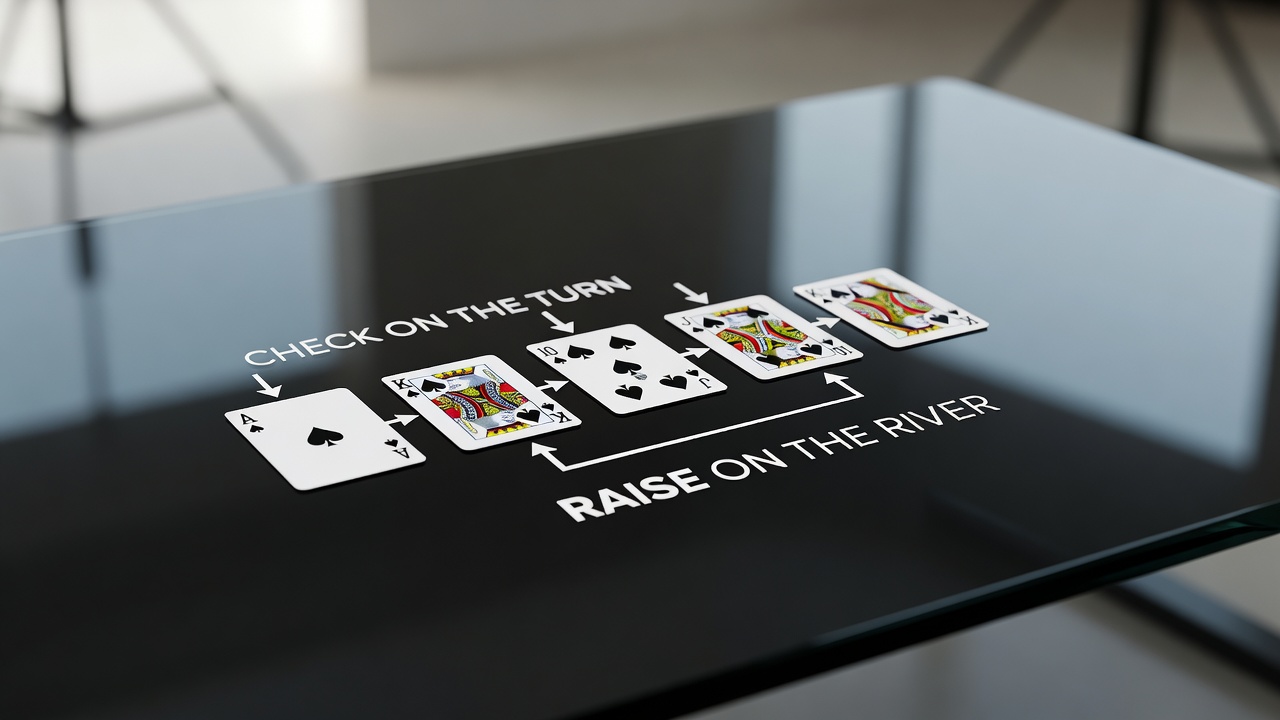
The check-raise is poker's closest thing to a trap. You check, your opponent bets, and then you raise them. It's simple. It's devastating. And it only works if they actually fall for it.
The Basic Mechanics
Let's start with what happens on paper. You're on the river. You have a strong hand. Instead of betting immediately, you check. Your opponent, thinking you're weak, bets. You raise. They now face a decision: call a larger amount, fold, or try to reraise. Most fold. That's the entire beauty of the check-raise.
A professional grinder will check-raise maybe 15-20% of their strong hands. The frequency matters. If you check-raise every time you hit the river, competent opponents stop betting into you. If you never check-raise, they exploit you by checking behind when they have medium-strength hands.
Why It Works
Your opponent's perception matters more than the cards do. When you check, they read weakness. Their brain fills in a story: you missed your flush draw, you have ace-high, you're giving up. They get excited. They bet big. Then you raise and that excitement curdles into regret.
The best check-raises happen against aggressive opponents. Someone who bets almost every river gives you endless opportunities. The tight player who only bets their premium hands? They won't take the bait often enough.
Execution
Timing is everything. You want your opponent to feel like they're stealing. If the pot is already massive and they're short-stacked, a bet from them isn't a sign of strength. It's desperation. A check-raise in that spot looks overly aggressive.
You also want the board texture to support your range. If you just called the flop on a safe board, a river check-raise should represent a strong hand. If you three-bet preflop, you can check-raise much wider because you already showed aggression.
The Double-Edged Sword
Check-raising puts money in the middle at a rate you don't control. That's the cost of the tool. Sometimes your opponent has the nuts. Sometimes they've been slow-playing a stronger hand than you thought. The trap sometimes catches the trapper.
Professionals check-raise because it works over time. Over 1000 hands, the fold equity and balance make it worth the occasional large loss. For a casual player, check-raising once per session and winning $50 might feel good. But if you're doing it without understanding position, board texture, and opponent tendencies, you're just another person who lost money trying to be clever.
The Math
Let's say the pot is $100. You have $50 behind. Your opponent bets $60 on the river. You raise to $150 total (adding $90). They fold 70% of the time. Your expected value is 0.70 times $60 (the original bet they made) plus 0.30 times whatever happens if they call. That's already $42 in expected value from the fold equity alone, without even counting the cases where you have the best hand and they call.
That math only works if they actually fold 70% of the time against your range. The moment they adjust and start calling more, the math breaks. That's when professionals tighten up and check-raise only their strongest holdings.
When Not to Check-Raise
Shallow stacks make check-raising pointless. If you have $20 left after a $50 river bet, a raise puts the decision in their hands immediately. There's no room for them to think, no illusion of control.
Multi-way pots get complicated fast. You can't control what two other players do, so you lose information. The check-raise works best heads-up or in pots where you've already eliminated most of the field.
The Real Edge
The check-raise isn't really about the hand you have. It's about the narrative you control. Your opponent believes a story. You had the pen the whole time. That's the only real edge poker gives you over variance and luck.