What You're Actually Betting On
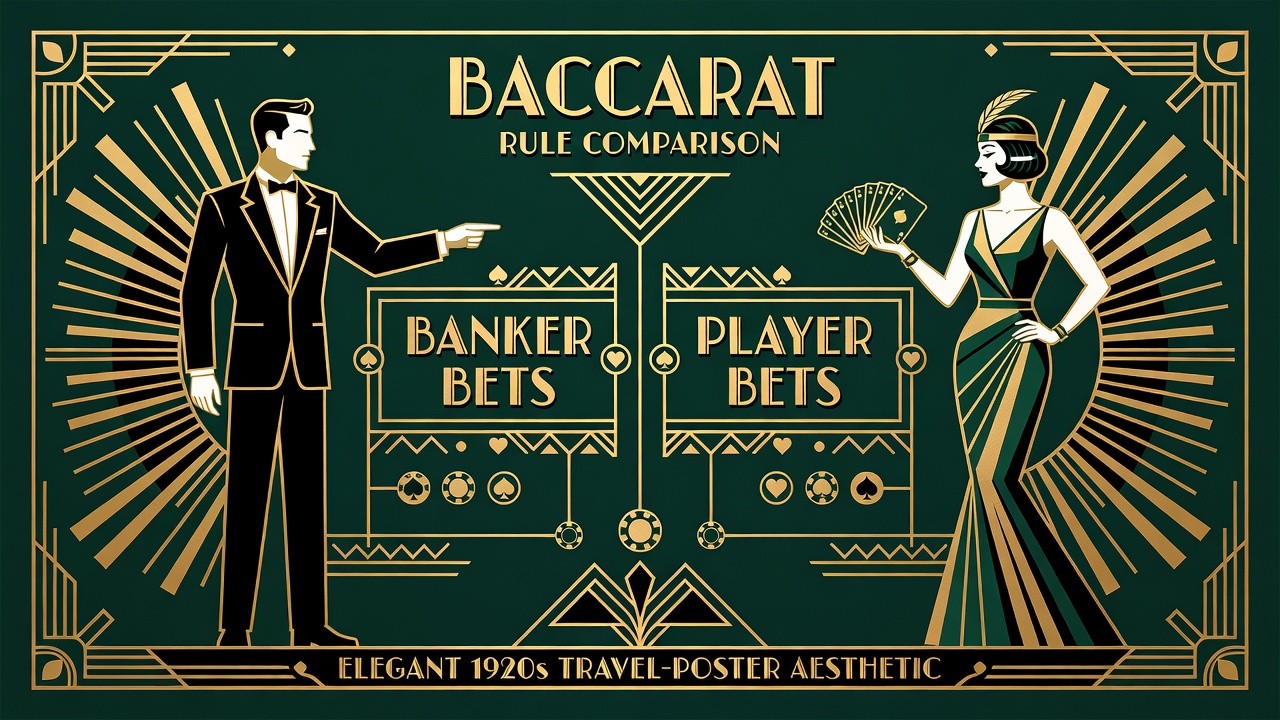
Baccarat is a betting game with two possible outcomes: the Banker hand wins, or the Player hand wins. You don't control either hand. You just bet on which one will win.
That's the core concept. Everything else is elaboration.
You are not the Player. There is no Player position. "Player" just means "one side of the table." The casino deals both hands. You choose which side to bet on.
Card Values
Aces are worth 1. Cards 2-9 are worth their face value. 10s, Jacks, Queens, Kings are worth 0.
This is where the "20" in Twenty-One doesn't apply. In baccarat, hands are scored on the final digit only. A hand of 9 plus 8 equals 17, but you write it as 7 (just the ones digit). A hand of 9 plus King equals 9 (because King is 0, so 9+0=9).
The goal is to get a hand whose total is closer to 9 than the other side.
The Draw Rules
Both hands start with 2 cards. If either hand totals 8 or 9, they stand. Those are "naturals" and the hand is over.
If neither hand has a natural, the Player hand acts first. The Player hand draws a third card if their total is 5 or less. They stand if their total is 6 or higher.
Then the Banker hand acts. The Banker's decision depends on what the Player drew and what the Banker's hand is. This is where it looks complicated, but it's just a chart.
You don't make these decisions. They're automatic rules. You just watch them unfold.
The Banker Advantage
The Banker position has a slight mathematical advantage because the Banker acts after seeing the Player's hand. The Banker knows whether the Player drew a card, and that information lets them make a better decision.
Because of this advantage, if the Banker hand wins, you get paid at 95:100, or "minus 5%." If the Player hand wins, you get paid at 100:100 (even money).
If it's a tie (both hands have the same total), neither side wins. You either get your bet back or you lose it, depending on how you bet. Some players will bet on a tie, which pays 8:1 or 9:1, but this is a sucker bet. Ties are rare and the payout doesn't make up for the probability.
The Marketing Confusion
Casinos and online betting sites will sometimes make baccarat sound like there's strategy involved. They'll talk about "trends" and "patterns" and "the shoes."
There's no strategy. The dealer has dealt the cards. The outcome is determined. You can't affect it by betting differently. You can't predict the next hand based on the previous hand because each hand is independent.
The only decision you make is whether to bet Player, Banker, or Tie. That's it. Everything else is marketing designed to make the game seem more sophisticated than it is.
The Real Action
You place your bet. The dealer gives the Player hand two cards (face down). The Banker hand two cards (face down). The cards are revealed. The draw rules are followed. One side wins.
You either collect money or lose your bet.
There's no bluffing. No choices. No strategy. Pure probability, settled instantly.
Why People Play It
Baccarat is the simplest casino game. Roulette, you're betting on colors and numbers. Blackjack, you're making hitting and standing decisions. Poker, you're making complex decisions constantly.
Baccarat: you bet, cards come out, one side wins. Done.
It's also historically associated with high stakes and serious players. The marketing around baccarat emphasizes its elegance and history. This makes people feel sophisticated for playing it.
But mechanically, it's the opposite of sophisticated. It's pure chance, with no skill component whatsoever.