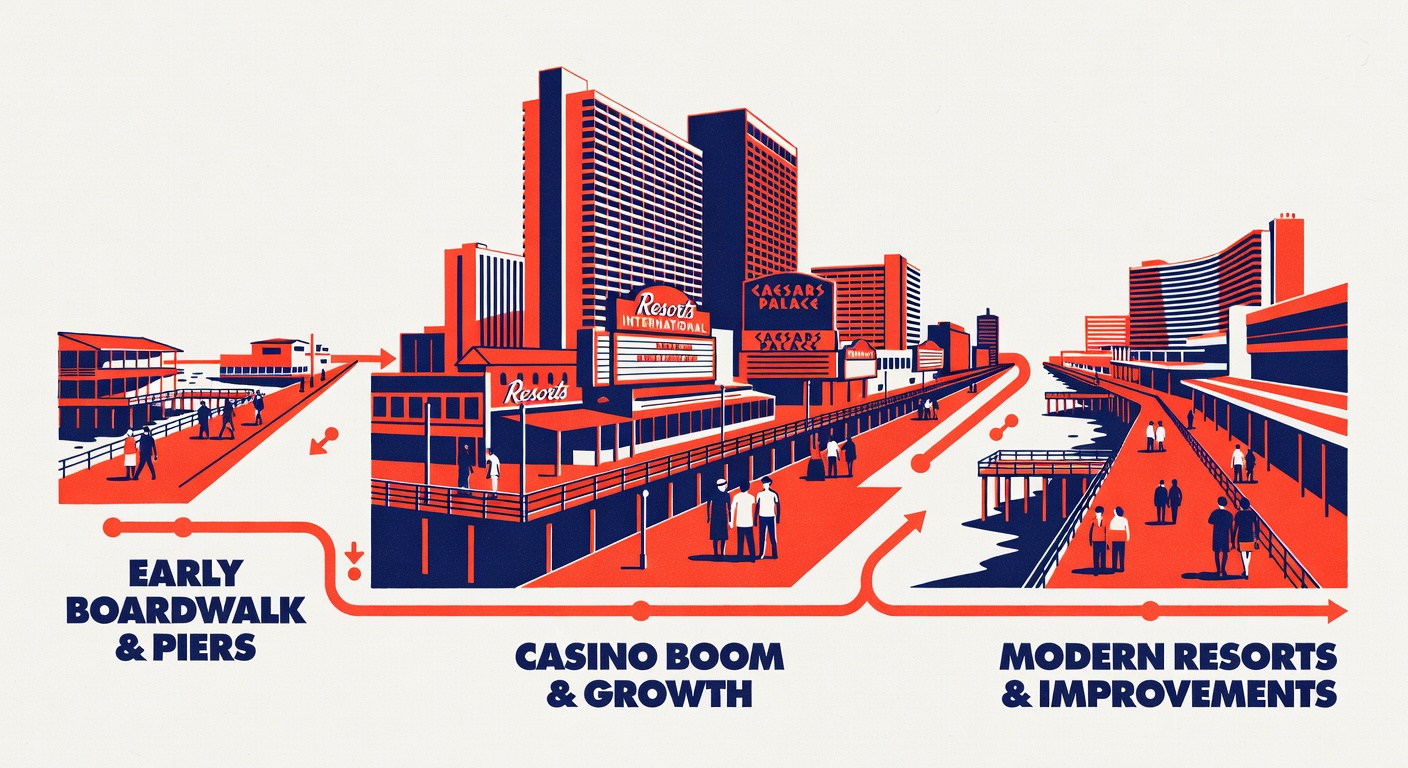
Atlantic City went all-in on casinos in 1978 and the whole East Coast is still picking up the chips. That's the take. Let me defend it.
The Boardwalk was built for something else entirely. Back in 1870, a local entrepreneur named Alexander Boardman, working with railroad interests, laid the first wooden walkway along the beach so hotels wouldn't get sand tracked into their lobbies. That's it. That's the origin story. Two railroad executives and one hotelier trying to solve a housekeeping problem. The name Boardwalk is literally just the walkway made of boards. Half the city's mythology starts with a janitorial complaint.
For the next hundred years the town was a straight-ahead seaside resort. Saltwater taffy. Boxing matches at Convention Hall. The Miss America Pageant, which launched there in 1921. Frank Sinatra did the 500 Club. The Marx Brothers played the Million Dollar Pier. It was Coney Island with better architecture.
Then came the 1960s. Air conditioning became standard in the American home. Jet travel made Miami and the Caribbean accessible. Atlantic City couldn't compete. By 1975 the city was bleeding population. Hotel occupancy was below 30% year-round. The Boardwalk was, not to put too fine a point on it, a full-court press that ran out of legs.
So New Jersey threw the Hail Mary.
The Referendum
A 1976 statewide referendum legalized casino gambling in Atlantic City. The argument: casinos would revive a dying resort town and fund senior citizen programs through a dedicated tax. The margin was 56% to 44%, which in Jersey politics is a blowout.
The first casino, Resorts International, opened on May 26, 1978. Lines stretched half a mile down the Boardwalk. The property grossed 224 million dollars in its first twelve months, a figure that had no historical comparison in American gaming. The Nevada industry, which had spent decades building its regulatory and operational playbooks, watched the Jersey opening week with a mixture of professional respect and genuine panic.
By 1980 Atlantic City had nine casinos operating. By 1985, eleven. Ceasar's, Bally's, the Sands, the Tropicana, the Claridge, Harrah's Marina. Each one a separate property, each one pulling tourists from Philadelphia, New York, Baltimore, DC. Within a weekend drive, more than sixty million Americans lived within three hours of an Atlantic City blackjack table.
This was the pinch-hit of the century. A dying resort town became the second-largest gambling market in the United States inside of seven years.
The Trump Era
Three Trump properties opened in Atlantic City between 1984 and 1990. The Trump Plaza in 1984. The Trump Castle in 1985. The Trump Taj Mahal in 1990. Peak Donald. Peak Atlantic City. The Taj Mahal's opening was the largest casino opening in American history at that point, with 120,000 square feet of gaming floor and a nightly property tax bill that would have bankrupted half the Midwestern resort towns the AC tourists had grown up visiting.
The Taj Mahal also filed for Chapter 11 protection in 1991. Less than twelve months after opening. This was the first warning shot.
The Slow Collapse
The short version is this: Atlantic City got outflanked by its neighbors. Foxwoods opened in Connecticut in 1992. Mohegan Sun in 1996. Pennsylvania legalized casinos in 2004. Maryland in 2008. New York full-scale in 2013. Each one took a regional slice out of the Atlantic City draw.
The gross gaming revenue peaked at 5.2 billion dollars in 2006. By 2014 it had fallen to 2.7 billion. Four properties closed that year alone. The Showboat. Revel, which had opened just two years earlier with a 2.4 billion dollar price tag. The Trump Plaza. Atlantic Club. In the pinch-hit analogy, the runner was thrown out at home.
The Current Play
Here's the honest version. Atlantic City is smaller now than it was at peak, but it is not dead. Seven casinos currently operate along the Boardwalk and the Marina District. Online gaming, legalized in New Jersey in 2013, has become a massive supplementary revenue stream, with the state's online casino gross gaming revenue exceeding 1.9 billion dollars annually by 2023. The town exports its regulatory brand, effectively, to the broader American igaming market.
The Boardwalk is no longer a destination. It is a node. And the node model works, as long as New Jersey continues to hold the regulatory high ground that Nevada spent forty years building.
The Prediction
Here is where I stake out the hot take. Atlantic City will not recover to its 2006 peak in gross gaming revenue. The regional competition is too entrenched, the convention business has permanently moved to Las Vegas and Orlando, and the demographic that drove Atlantic City's 1980s bus-trip business has aged out.
But Atlantic City is going to survive, and it will survive on a hybrid model: a smaller resort footprint, a large online operation, and the specific regulatory credibility that comes from being the only non-tribal East Coast gaming jurisdiction with a four-decade track record of enforcement. That is not a comeback. That is a positional play in the neutral zone.
The concession to the counterargument: if Pennsylvania or New York ever gets ambitious about full-scale integrated resort development with real convention capacity, Atlantic City loses the last structural advantage it has. The Jersey legislature knows this. That is why the next ten years of regulatory and tax policy in Trenton matter more than the next ten years of marketing budgets in AC.
The Boardwalk started as a solution to sand tracked into hotel lobbies. It is now a 150-year-old experiment in whether a coastal resort can continuously reinvent itself under the pressure of its larger competitors.
The answer, so far: maybe.