
3 Card Poker Hands Ranked: Why Straights Beat Flushes
Three cards flip the usual order: 720 straights against 1,096 flushes. The hand ranks, the ace's two ends, and what Pair Plus tables cost.
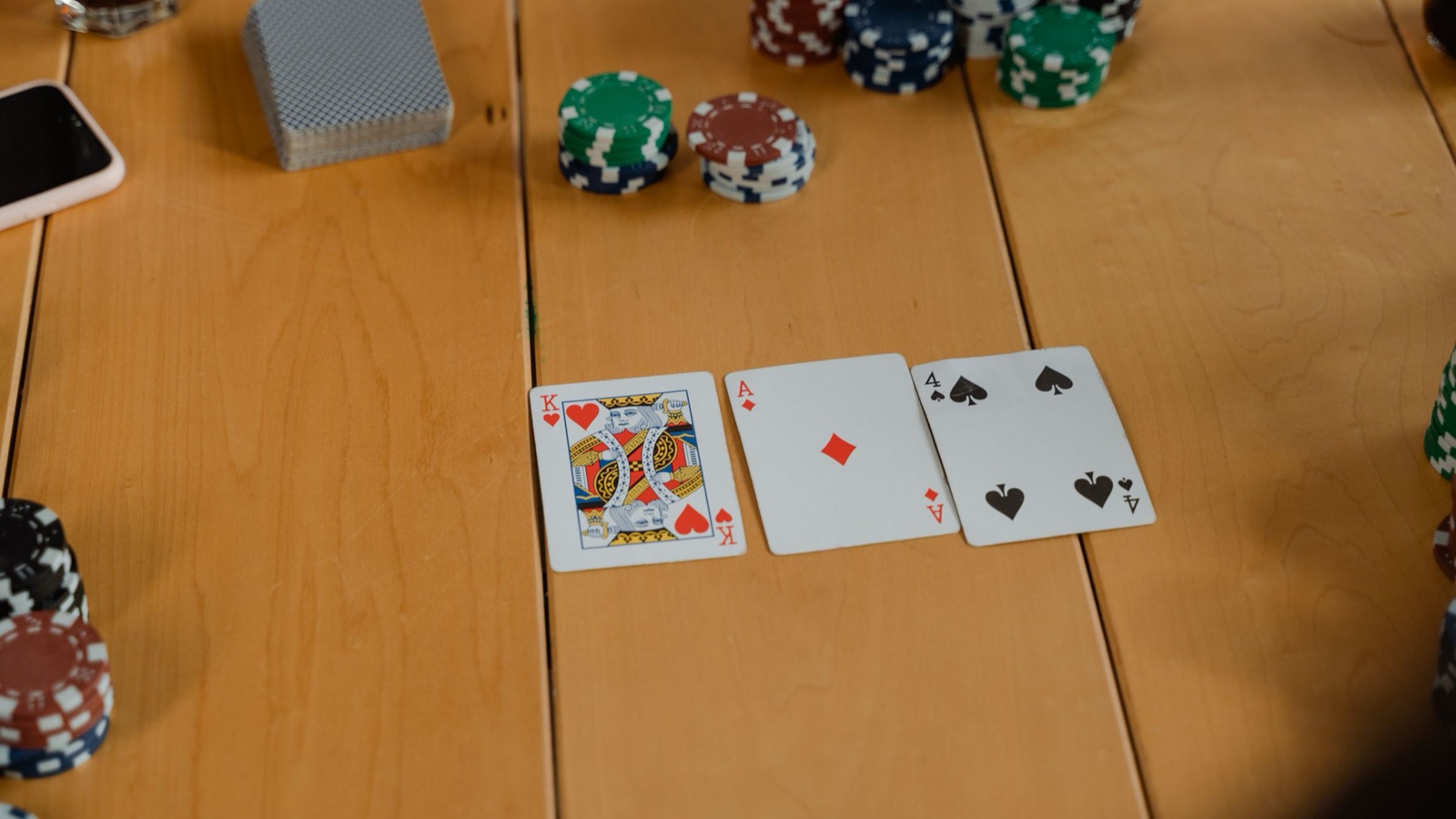
Photo: Mart Production on Pexels
In Three Card Poker the hands rank, from the top: straight flush, three of a kind, straight, flush, pair and high card. The order departs from the familiar five-card list for one reason. With only three cards a straight is harder to make than a flush, and the Wizard of Odds combination count shows it plainly: 720 ways to deal a straight against 1,096 ways to deal a flush. The rarer hand ranks higher, and the same arithmetic later sets the price of the Pair Plus bet.
Three Card Poker hands in rank order
The 3 card poker hands, best to worst, are catalogued below with the number of three-card deals that make each one, as counted by the Wizard of Odds (as of October 2026). Only the counts the source publishes appear here.
| Hand | What it is | Deals that make it |
|---|---|---|
| Straight flush | Three suited cards in sequence | 48 |
| Three of a kind | Three cards of one rank | 52 |
| Straight | Three in sequence, mixed suits | 720 |
| Flush | Three suited cards, not in sequence | 1,096 |
| Pair | Two cards of one rank | 3,744 |
| High card | None of the above | The remainder |
Two quirks stand out in the ledger. Three of a kind, with 52 deals, is barely more common than the straight flush at 48, yet it ranks beneath it. And the pair, at 3,744 deals, is the first hand a reader will meet with any regularity.
Why a straight outranks a flush with three cards
A straight beats a flush in this game because it is the scarcer hand. In five-card poker the extra cards make a flush rarer than a straight; strip the hand down to three and the relationship reverses.
The definitions keep the two categories apart. California Bureau of Gambling Control rules describe a straight as three cards "in consecutive ranking, but that are not the same suit", and California's definition of a flush is three suited cards "that are not in consecutive ranking". A suited run therefore belongs to neither: it is a straight flush. The Massachusetts Gaming Commission rules word the flush more loosely, as three suited cards "regardless of rank", though a suited run still ranks as the straight flush above it.
Where the ace plays, and the Mini Royal
The ace works at both ends of a sequence. California lists ace, 2, 3 as the lowest straight, and Massachusetts lets an ace complete a straight or straight flush low with a two and three, naming three, two, ace the lowest straight flush in its 2018 rules.
At the other end, California gives ace, king and queen of one suit a name of its own: a Mini Royal Flush, entered at the head of its hand list. Massachusetts simply calls the same three cards the highest straight flush. The hand is identical; only the catalogue entry differs by state. For how combinations like these are tallied in the full deck, see how poker probability for hands is counted.
How the counts shape the Pair Plus house edge
Pair Plus pays on the strength of the player's own three cards, and its paytable steps down in the same order as the hand counts: the rarer the hand, the larger the pay. Under the Massachusetts bonus paytable, only the highest hand pays, so a straight flush is not also paid as a flush.
What the house keeps depends on which table is posted. As of October 2026 the Wizard of Odds puts the most common Pairplus pay table at a house edge of 7.28%. Across the ten pay tables it lists, the common range runs from 2.32% to 7.28%, with rarer tables lower still, down to 0.00%. The commonest table, in other words, sits at the expensive end of the shelf.
From the reference desk
What are the top 3 best hands in Three Card Poker?
From the top: the straight flush (led by ace, king, queen of one suit, which California files as a Mini Royal Flush), then three of a kind, then the straight. The flush sits fourth because three suited cards turn up more often than three in sequence.
Should you always bet Pair Plus in 3-card poker?
Nothing in the rule books makes it compulsory, and the price varies by table. As of October 2026 the Wizard of Odds puts the most common Pair Plus table at a 7.28% house edge, with the usual range running from 2.32% upward, so the posted paytable is the thing to read first.
Is 3 card poker worth playing?
That depends on what a player wants from it, but the cost of the side bet is a matter of record: it is set by the paytable on the felt, and the common tables differ by several points of house edge.
Bibliography
- California Department of Justice, Bureau of Gambling Control. Three Card Poker: Rules. Undated; accessed October 27, 2026.
- Massachusetts Gaming Commission. Three Card Poker. July 26, 2018.
- Wizard of Odds. Three Card Poker Strategy, Rules & Odds. Undated; accessed October 27, 2026.

Filed on
Shelved alongside
- PK·O528
Omaha Poker Odds Calculator: Checking the Math by Hand
Every Omaha equity tool rests on one rule and a few counts: 270,725 hands, 16,432 distinct starts, two hole cards always. Here is how to audit the output.
By Play Trump Casino Reading Room
- PK·U579
Ultimate Texas Holdem Poker Rules and the House Edge
California's approved Ultimate Texas Hold'em rules, the single raise, how each bet pays, and why a 2.185% edge per Ante is about 0.526% of total action.
By Play Trump Casino Reading Room
- PK·P651
Probability of Poker Hands: How the Counting Works
Why a royal flush runs 1 in 649,740 and one pair 1 in 2.37, how flushes are counted, and why seven-card Hold'em keeps the same order.
By Play Trump Casino Reading Room
- PK·P674
Pot-Limit Omaha Starting Hands You Should Never Fold
What is certainty in a game of four cards? The ancient question returns: which hands justify commitment before the unknowable flop reveals itself?
By Play Trump Casino Reading Room